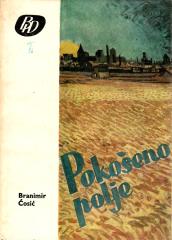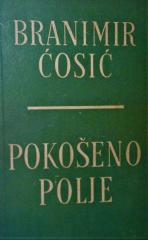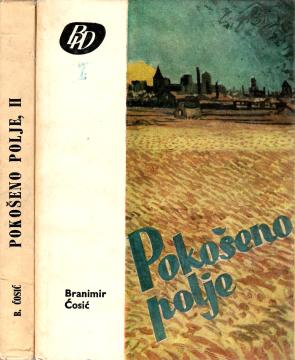
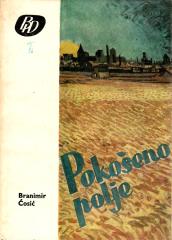
Pokošeno polje

Pokošeno polje

Branimir Ćosić

Mown Fields (1933) represents the culmination and swan song of a life that ended too soon – the author finished the novel just five months before his death from tuberculosis, at the age of thirty-one.

A book deeply imbued with personal pain and a broad picture of a broken time, where war trauma and post-war decadence intertwine into a difficult, inevitable whole. The first part of the novel bears a strong autobiographical imprint: through the eyes of a child and a young man, the horrors of World War I are brought to life – hunger, occupation, a devastated village, the loss of family and innocence. It is a world in which youth is mown down like a field under a mower, where national pride mixes with humiliation, and everyday life becomes a struggle for bare survival. Ćosić does not romanticize suffering; it is raw, tangible, leaving deep scars that never heal.

The second part shifts to Belgrade in the interwar years – a city of corruption, false ideals, moral collapse and existential emptiness. The main character, a journalist and intellectual, wanders through a gallery of failed characters: cynics, opportunists, petty bourgeois who have adapted to the new order. Ćosić’s criticism is harsh, but not pamphlet-like – it comes from within, from the disappointment of a generation that survived the war to witness the disintegration of all the values ​​it fought for. Love, friendship, faith in a better tomorrow – everything crumbles under the weight of time.

The style of the novel is urban, modern, psychologically profound, with a fragmentary flow that reflects inner unrest. There is no pathos, no embellishment; Ćosić writes with bare, almost documentary precision, but with warmth towards the disenfranchised and wounded. The title – a mowed field – is not just a metaphor for destroyed youth; it is an image of an entire era, where life is mowed before it blooms.

Dimenzije
17 x 12 cm
Ukupan broj strana
499
Nakladnik
Svjetlost, Sarajevo, 1961.
 
Latinica. Tvrde korice.
Jezik: Srpski.

Knjiga se sastoji od dva toma.

Jedan višetomni primjerak je u ponudi.
Dodano u košaricu!

Pokošeno polje
Prvi tom
Broj strana: 187
Stanje:Korišteno, u odličnom stanju
Pokošeno polje
Drugi tom
Broj strana: 312
Stanje:Korišteno, u odličnom stanju
 

Zanima Vas i neka druga knjiga? Možete pretražiti našu ponudu pomoću tražilice ili prelistati knjige po kategorijama.

Možda će Vas zanimati i ovi naslovi

Pokošeno polje

Pokošeno polje

Branimir Ćosić

„Pokošeno polje“ je najznačajniji i poslednji roman srpskog pisca Branimira Ćosića (1903–1934), završen 1933. godine, samo pet meseci pre njegove smrti od tuberkuloze u 31. godini života.

Nakladni zavod Hrvatske, 1949.
Srpski. Latinica. Tvrde korice.
5,50
Sanjaj nemogući san

Sanjaj nemogući san

Johannes Mario Simmel

Od autora bestselera „Džimi i duga“ dolazi roman koji isprepliće ljubavnu priču sa uzbudljivim događajima bosanskog rata. Ova priča, utkana u istorijski kontekst, podseća nas da je ponekad nemoguć san jedini vredan sanjanja.

Mozaik knjiga, 1997.
Hrvatski. Latinica. Tvrde korice.
7,425,19
Celokupna dela III: Tri ratna druga

Celokupna dela III: Tri ratna druga

Erich Maria Remarque
Minerva, 1978.
Srpski. Latinica. Tvrde korice.
3,99 - 8,98
Tamo gdje nema rata

Tamo gdje nema rata

Nada Prkačin
Privlačica, 1993.
Hrvatski. Latinica. Broširano s ovitkom.
2,98 - 2,99
Okus krvi

Okus krvi

David Morrell

Vijetnamski veteran Džon Rambo uhapšen je u malom gradu zbog skitničenja. Traumatizovan ratom, beži iz pritvora u planine, pokrećući brutalnu poteru. Šerif Tisl ga opsesivno progoni dok sukob eskalira u privatni rat koji uništava ceo grad.

Otokar Keršovani, 1987.
Hrvatski. Latinica. Broširano.
13,46
Odsustvo do buđenja

Odsustvo do buđenja

Leon Uris

„Odsustvo do buđenja“ (1953) je debitantski roman Leona Urisa zasnovan na njegovom iskustvu u Drugom svetskom ratu kao pripadnika 6. marinskog puka.

Otokar Keršovani, 1970.
Hrvatski. Latinica. Tvrde korice s ovitkom.
8,24