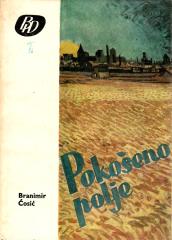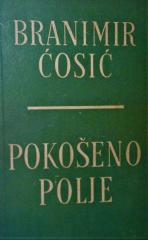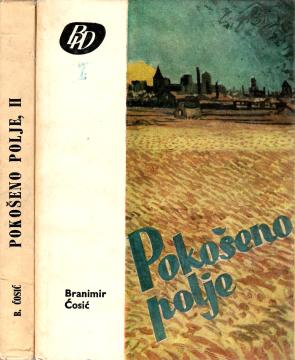
Pokošeno polje

Pokošeno polje

Branimir Ćosić

Mown Fields (1933) represents the culmination and swan song of a life that ended too soon – the author finished the novel just five months before his death from tuberculosis, at the age of thirty-one.

A book deeply imbued with personal pain and a broad picture of a broken time, where war trauma and post-war decadence intertwine into a difficult, inevitable whole. The first part of the novel bears a strong autobiographical imprint: through the eyes of a child and a young man, the horrors of World War I are brought to life – hunger, occupation, a devastated village, the loss of family and innocence. It is a world in which youth is mown down like a field under a mower, where national pride mixes with humiliation, and everyday life becomes a struggle for bare survival. Ćosić does not romanticize suffering; it is raw, tangible, leaving deep scars that never heal.

The second part shifts to Belgrade in the interwar years – a city of corruption, false ideals, moral collapse and existential emptiness. The main character, a journalist and intellectual, wanders through a gallery of failed characters: cynics, opportunists, petty bourgeois who have adapted to the new order. Ćosić’s criticism is harsh, but not pamphlet-like – it comes from within, from the disappointment of a generation that survived the war to witness the disintegration of all the values ​​it fought for. Love, friendship, faith in a better tomorrow – everything crumbles under the weight of time.

The style of the novel is urban, modern, psychologically profound, with a fragmentary flow that reflects inner unrest. There is no pathos, no embellishment; Ćosić writes with bare, almost documentary precision, but with warmth towards the disenfranchised and wounded. The title – a mowed field – is not just a metaphor for destroyed youth; it is an image of an entire era, where life is mowed before it blooms.

Dimensions
17 x 12 cm
Pages total
499
Publisher
Svjetlost, Sarajevo, 1961.
 
Latin alphabet. Hardcover.
Language: Serbian.

The book consists of two volumes.

Jedan višetomni primjerak je u ponudi.
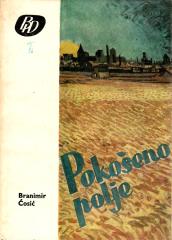
Pokošeno polje
Volume 1
Pages: 187
Condition:Used, excellent condition
Pokošeno polje
Volume 2
Pages: 312
Condition:Used, excellent condition
 

Are you interested in another book? You can search the offer using our search engine or browse books by category.

You may also be interested in these titles

Pokošeno polje

Pokošeno polje

Branimir Ćosić

Pokošeno polje je najznačajniji i posljednji roman srpskog pisca Branimira Ćosića (1903.–1934.), dovršen 1933. godine, samo pet mjeseci prije njegove smrti od tuberkuloze u 31. godini.

Nakladni zavod Hrvatske, 1949.
Serbian. Latin alphabet. Hardcover.
5.50
Zmija oko vrata I-II

Zmija oko vrata I-II

Lydia Scheuermann-Hodak

Ratno-psihološka proza smještena u vrijeme Domovinskog rata (1991.–1995.), s fokusom na Slavoniju i dijelom na zbivanja u Bosni. Djelo pripada ciklusu proze o ratu i ženskom iskustvu u njemu.

Grafika, 2004.
Croatian. Latin alphabet. Paperback.
The book consists of two volumes
9.76
Zaboravljene djevojke

Zaboravljene djevojke

Martha Hall Kelly

Roman „Zaboravljena devojka“ zasnovan je na stvarnom životu pripadnice njujorških otmenih krugova, koja se borila za prava Kunićevih, grupe žena koje su preživele strahote koncentracionog logora Ravensbrik.

Mozaik knjiga, 2018.
Croatian. Latin alphabet. Paperback.
7.98
Mirni Amerikanac

Mirni Amerikanac

Graham Greene

„Tihi Amerikanac“ (1955) smešten je u Vijetnam pedesetih godina 20. veka, tokom francuske kolonijalne borbe protiv pobunjenika. Kroz atmosferu Sajgona, Grin stvara napetu priču o ljubavi i političkim intrigama, sa snažnom kritikom Vijetnamskog rata i šire

Bratstvo-Jedinstvo, 1968.
Serbian. Latin alphabet. Paperback.
4.26
Iskra života

Iskra života

Erich Maria Remarque

„Iskra života“ prati grupu zatvorenika u nacističkom koncentracionom logoru koji, uprkos stalnom teroru, zadržavaju svoju moralnu snagu i čovečnost. Roman prikazuje borbu duha protiv sistematskog uništenja i potrebu za nadom.

Džepna knjiga, 1955.
Serbian. Latin alphabet. Paperback.
3.24
Sanjaj nemogući san

Sanjaj nemogući san

Johannes Mario Simmel

Od autora bestselera „Džimi i duga“ dolazi roman koji isprepliće ljubavnu priču sa uzbudljivim događajima bosanskog rata. Ova priča, utkana u istorijski kontekst, podseća nas da je ponekad nemoguć san jedini vredan sanjanja.

Mozaik knjiga, 1997.
Croatian. Latin alphabet. Hardcover.
7.42