Maksim Gorki
Maxim Gorki (richtiger Name Alexey Maksimovich Peshkov) wurde am 28. März 1868 in Nischni Nowgorod geboren und starb am 18. Juni 1936 in Moskau. Er war ein russischer Schriftsteller, Revolutionär und politischer Aktivist. Sein Name wurde zum Synonym für sozialen Realismus und Literatur, die der Arbeiterklasse gewidmet war.
Er wuchs unter schwierigen Bedingungen auf und musste nach dem Tod seiner Eltern verschiedene Arbeiten verrichten. Eine starke soziale Sensibilität prägte sein Schaffen und er verarbeitete Erfahrungen aus seiner Jugend in literarischen Werken. Er wurde einer der wichtigsten russischen Schriftsteller des Übergangs vom 19. zum 20. Jahrhundert und ein wichtiger Ideologe des sozialistischen Realismus.
Zu seinen wichtigsten Werken zählen:
Autobiografische Trilogie: Kindheit (1913), In der Welt (1916), Meine Universitäten (1923)
Der Roman Mati (1906) – ein Schlüsselroman des sozialen Realismus
Kurzgeschichten und Sammlungen: Rund um Russland (1923), Märchen über Italien (1911), Russische Märchen
Drama Na dnu (1902) – eines seiner berühmtesten Theaterwerke
Gorki engagierte sich im politischen Leben, beteiligte sich an der Revolution von 1905, lebte im Exil und kehrte 1932 in die UdSSR zurück, wo er zum Symbol der sowjetischen Literatur wurde.
Naslovi u ponudi
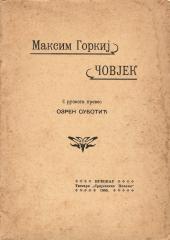
Čovjek
Čovek od Maksima Gorkog, u prevodu Ozrena Subotića (Vukovar, 1905), je filozofsko i književno delo koje veliča dostojanstvo čoveka, njegovu stvaralačku moć, slobodu duha i borbu protiv društvene nepravde.
Djela #11: Gradić Okurov / Život Matveja Kožemjakina
The story "Gradić Okurov" is a short novel written by Gorki in 1909. The work depicts the life of the small provincial town of Okurova and its inhabitants, focusing on the monotony, stagnation and moral decadence of society.
Djela #13: Po Rusiji
"Around Russia" is a collection of short stories by Maxim Gorky, published between 1911 and 1917. This collection contains stories that depict the life and spirit of the Russian people during the turmoil of the early 20th century.
Djela #14: Bajke o Italiji / Ruske bajke / Balada o grofici Elen de Kursi
"Tales of Italy" is a collection of short stories by Maxim Gorky, written during his stay in Italy at the beginning of the 20th century. "Russian Fairy Tales" is Gorky's interpretation of traditional Russian folk tales.
Djela #15: Pripovetke / Drame
The book contains the following stories and plays: Three Days, Theft, Criminals, Thefts, Fake Money and The Old Man.
Djela #16: Djetinjstvo
The first part of Gorky's autobiographical trilogy, published in 1913, depicts the author's difficult upbringing under the Tsarist regime. The book follows Alexei Peshkov (real name Maxim Gorky) from his early childhood to his teenage years.
Djela #17: U svijetu
„U svetu“ je drugi deo autobiografske trilogije Maksima Gorkog, objavljene 1916. godine. Trilogija obuhvata dela „Detinjstvo”, „U svetu” i „Moji univerziteti”, pružajući uvid u godine formiranja autora.
Djela #18: Moji univerziteti
Pored autobiografskog dela „Moji univerziteti“, ovaj tom sadrži i autobiografske pripovetke Stražar, Koroljenkovo doba, O šteti filozofije i O prvoj ljubavi.
Djela #7: U Americi / Moji intervjui / Vojnici / Neprijatelji
Maksim Gorki boravio je u Sjedinjenim Američkim Državama 1906. godine. Tijekom tog razdoblja napisao je nekoliko djela, mahom kao odgovor na neuspjeh ruske revolucije 1905. godine.