Maksim Gorki
Maxim Gorky (real name Alexei Maksimovich Peshkov) was born on March 28, 1868 in Nizhny Novgorod and died on June 18, 1936 in Moscow. He was a Russian writer, revolutionary, and political activist. His name became synonymous with social realism and literature dedicated to the working class.
He grew up in difficult conditions, and after the death of his parents, he was forced to work various jobs. Strong social sensitivity shaped his creativity, and he translated the experiences of his youth into literary works. He became one of the key Russian writers of the turn of the 19th to the 20th century and an important ideologist of socialist realism.
His most important works include:
Autobiographical trilogy: Childhood (1913), In the World (1916), My Universities (1923)
Novel Mother (1906) – a key novel of social realism
Short stories and collections: Around Russia (1923), Fairy Tales of Italy (1911), Russian Fairy Tales
Drama At the Bottom (1902) – one of his most famous theatrical works
Gorky was active in political life, participated in the 1905 revolution, lived in exile, and returned to the USSR in 1932, where he became a symbol of Soviet literature.
Titel im Angebot
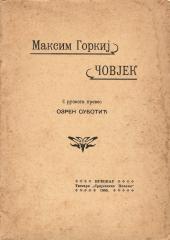
Čovjek
Čovjek Maksima Gorkog, u prijevodu Ozrena Subotića (Vukovar, 1905.), filozofsko-je književno djelo koje veliča dostojanstvo čovjeka, njegovu stvaralačku snagu, slobodu duha i borbu protiv društvene nepravde.
Djela #11: Gradić Okurov / Život Matveja Kožemjakina
Priča "Gradić Okurov" je kraći roman koji je Gorki napisao 1909. godine. Djelo prikazuje život malog provincijskog grada Okurova i njegovih stanovnika, fokusirajući se na monotoniju, stagnaciju i moralnu dekadenciju društva.
Djela #13: Po Rusiji
"Po Rusiji" zbirka je pripovijedaka Maksima Gorkog, objavljena između 1911. i 1917. godine. Ova zbirka sadrži priče koje oslikavaju život i duh ruskog naroda tijekom previranja početkom 20. stoljeća.
Djela #14: Bajke o Italiji / Ruske bajke / Balada o grofici Elen de Kursi
„Märchen über Italien“ ist eine Sammlung von Geschichten von Maxim Gorki, die während seines Aufenthalts in Italien zu Beginn des 20. Jahrhunderts entstanden sind. „Russische Märchen“ stellen Gorkis Interpretation traditioneller russischer Volksmärchen da
Djela #15: Pripovetke / Drame
Das Buch enthält die folgenden Kurzgeschichten und Dramen: Three Days, Theft, Criminals, Zikovi, Fake Money und The Old Man.
Djela #16: Djetinjstvo
Der erste Teil von Gorkis autobiografischer Trilogie, erschienen 1913, schildert die schwierige Erziehung des Autors unter dem zaristischen Regime. Das Buch folgt Alexei Peshkov (richtiger Name Maxim Gorki) von seiner frühen Kindheit bis zu seinen Teenage
Djela #17: U svijetu
„In der Welt“ ist der zweite Teil der 1916 erschienenen autobiografischen Trilogie Maxim Gorkis. Die Trilogie umfasst die Werke „Kindheit“, „In der Welt“ und „Meine Universitäten“ und gibt einen Einblick in die prägenden Jahre des Autors.
Djela #18: Moji univerziteti
Neben dem autobiografischen Werk „Meine Universitäten“ enthält dieser Band auch die autobiografischen Kurzgeschichten Stražar, Koroljenkos Zeitalter, Über den Schaden der Philosophie und Über die erste Liebe.
Djela #7: U Americi / Moji intervjui / Vojnici / Neprijatelji
Maksim Gorki je boravio u Sjedinjenim Američkim Državama 1906. godine. Tokom ovog perioda, napisao je nekoliko dela, uglavnom kao odgovor na neuspeh Ruske revolucije 1905.