Gepard

Gepard

Giuseppe Tomasi Di Lampedusa

"The Cheetah" is not just a historical novel - it is a meditation on time, change and the Sicilian soul. The style is sumptuous, ironic and deeply sad. Published posthumously, it has become one of the greatest Italian novels of the 20th century and a worl

Sicily, May 1860. As Garibaldi disembarks his red shirts to overthrow the Bourbons, Prince Fabrizio Salina, “The Cheetah,” an old-school aristocrat, watches his world disappear before his eyes. The novel follows the last seven years of his life (1860–1883) and the fate of his family through the unification of Italy.

The central figure is Fabrizio – wise, melancholic, aware that his class is doomed to extinction. His nephew Tancredi, an opportunist and charming cynic, utters the key sentence: “If we want everything to remain the same, everything must change.” Tancredi, after a brief Garibaldian episode, marries Angela, daughter of the wealthy and vulgarly ambitious mayor Don Calogero Sedàra – symbol of the new bourgeoisie taking power.

Through magnificent scenes (a ball in Palermo in 1862, a quail hunt, family dinners, the death of a prince in 1883, and the final collapse in 1910), Lampedusa paints an elegy for a world: an aristocracy that is disappearing not because of violence, but because it no longer has a function. Everything is transient – ​​beauty, power, faith, even death itself.

“We were lions and cheetahs, and in our place come jackals and hyenas… but we will all, cheetahs and lions, jackals and sheep, continue to think that we are the salt of the earth.”

Original title
Il gattopardo
Translation
Mate Maras
Editor
Milan Mirić
Graphics design
Alfred Pal
Dimensions
21 x 12.5 cm
Pages
288
Publisher
Sveučilišna naklada Liber (SNL), Zagreb, 1982.
 
Latin alphabet. Hardcover with dust jacket.
Language: Croatian.

One copy is available

Condition:Used, excellent condition
 

Are you interested in another book? You can search the offer using our search engine or browse books by category.

You may also be interested in these titles

„Dosje“ i druge priče

„Dosje“ i druge priče

Nikola Đuretić

If we know how to listen, it will whisper to us how complicated life is. No other recommendations are needed for this prose by Đuretić.

Društvo hrvatskih književnika, 2024.
Croatian. Latin alphabet. Paperback.
7.96
Bambusov štap

Bambusov štap

Anto Staničić
NIRO Književne novine, 1982.
Croatian. Latin alphabet. Hardcover with dust jacket.
4.39
Urota zrinsko-frankopanska

Urota zrinsko-frankopanska

Eugen Kumičić

For about ten years, the novel was the most widely read book, which, thanks to the interest of the readers of that time in the historical events that marked the time of the conspiracy of Croatian and Hungarian noblemen against the Austrian crown, had a hu

Katarina Zrinska, 1993.
Croatian. Latin alphabet. Hardcover.
7.54
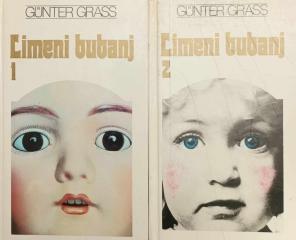
Limeni bubanj 1-2.

Limeni bubanj 1-2.

Günter Grass

The main character Oskar Matzerath, born in Gdańsk in 1924, tells his life from the point of view of a three-year-old child. On his third birthday, he decided not to grow up, and from that day on, his story about the view of the adult world begins.

Sveučilišna naklada Liber (SNL), 1981.
Croatian. Latin alphabet. Hardcover.
The book consists of two volumes
20.36
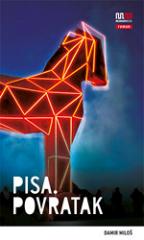
Pisa. Povratak

Pisa. Povratak

In the third part of the trilogy "Pisa (Return)", following in the footsteps of the previous books "Smetlar" and "Cesta", Damir Miloš, not for the first time, questions the space of storytelling and narration, building tension between opposing and incompa

Meandar, 2011.
Croatian. Latin alphabet. Paperback.
5.32
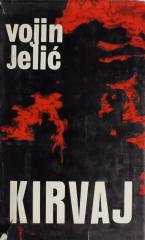
Kirvaj

Kirvaj

Vojin Jelić
Naprijed, 1970.
Croatian. Latin alphabet. Hardcover with dust jacket.
1.99