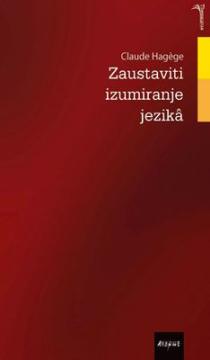
Zaustaviti izumiranje jezikâ

Zaustaviti izumiranje jezikâ

Claude Hagège

The author bases his research on the insight that - if nothing changes - in about a hundred years, out of today's approximately 5,000 living languages, half of them will die out. He is particularly worried about the fact that this cataclysm is taking plac

Hagège warns of the urgent need to do something so that human cultures stop disappearing into the abyss of oblivion. At the same time, his broad knowledge of languages ​​allows him to penetrate to the smallest details from the past of Latin, Sanskrit, Arabic, Sumerian, Gothic and many other languages.

In the first part of the book, the author deals with the close connection between languages ​​and the basic principles of life that govern the universe. Since languages ​​give life and at the same time preserve the past, we can in a certain way observe them as living species. In order to understand what the disappearance of a language actually means and how it differs so much from the disappearance of other species, it is enough to determine its essential feature: speech. Speech is short-lived and erratic, but language does not die completely if there is no speech.

The second part of the book talks about what should be understood by the extinction of a language, what kind of process it is, what are its causes, and what it represents for our species, and finally what actions we can take to prevent language extinction. The author explains three profiles of language disappearance: transformation (the birth of new languages, for example from Latin), substitution (the process of fusion with another dominant language) and extinction (the death of the last original speakers), with extinction being the most current phenomenon today. The reasons for the disappearance of languages ​​are manifold, and the most common political reason is "linguicide" by the state (linguistic hegemony that suppresses weaker languages), and the economic reason is the pressure of a more powerful economic system that leads to a decline in the prestige of peripheral languages, and therefore the need to know the language of the dominant one is imposed. system. Like Latin once, today English is exterminating many languages. Thanks to modern technologies and means of communication, the strength and speed with which English is spreading in the world today greatly exceeds the strength and speed that in the past enabled some languages, for example Latin, to completely wipe out a large number of languages.

According to the author, there are four fundamental moves that can help languages: bilingual education programs, declaring the language official, involving the speakers themselves in the revival of their own language, and the work of linguists (both on describing the factual situation and on creating a positive awareness of the language).

In the chapter "Languages ​​and Resurrection", the author mainly talks about the resurrection of Hebrew, which is an impressive phenomenon, so far unique in terms of its importance and degree of completion. Although it was without a "speech" for several centuries, today it is the language of an entire country. He then mentions several other interesting cases, including the resurrection of the Croatian language. With the political promotion of the Croatian language after gaining independence, the Croats are enriching Europe with another language today, which is indescribably important if the scale of the linguistic cataclysm is taken into account.

Naslov originala
Halte à la mort des langues
Prevod
Ivana Franić
Naslovnica
Goran Grčić
Dimenzije
21 x 14 cm
Broj strana
316
Izdavač
Disput, Zagreb, 2005.
 
Latinica. Tvrde korice.
Jezik: Hrvatski.

Jedan primerak je u ponudi

Stanje:Nekorišćeno
Dodato u korpu!
 

Zanima Vas i neka druga knjiga? Možete pretražiti našu ponudu pomoću pretrage ili prelistati knjige po kategorijama.

Možda će Vas zanimati i ovi naslovi

Riječ materinska

Riječ materinska

Dragutin Rosandić

The Word of Mother is a linguistic and methodological monograph on teaching the mother tongue outside the homeland in conditions of bilingualism. It sheds light on the issues of bilingualism as a sociolinguistic, psycholinguistic and methodological phenom

Školska knjiga, 1983.
Hrvatski. Latinica. Tvrde korice s omotom.
3,86
Semantika

Semantika

Gaetano Berruto

Berruto explains what meaning is in language and how it is formed, interpreted, and transmitted. He elaborates on different approaches to semantics, including the relationship between words, concepts, and reality.

Aktant d. o. o., 1994.
Hrvatski. Latinica. Broširano.
7,98
Jezik oko nas

Jezik oko nas

Ivan Klajn
Nolit, 1980.
Srpski. Latinica. Tvrde korice.
4,00
Deklaracija o nazivu i položaju hrvatskog književnog jezika

Deklaracija o nazivu i položaju hrvatskog književnog jezika

Dalibor Brozović, Stjepan Babić, Mladen Čaldarović, Josip Pavičić, Miroslav Brandt, Lovro Županov...

Material for the history of the Declaration (1967-1997). Third revised edition. The booklet was printed on the occasion of the thirtieth anniversary of the publication of the Declaration.

Matica hrvatska, 1997.
Hrvatski. Latinica. Broširano.
3,52 - 3,56
Red reči: Lingvistički ogledi, četiri

Red reči: Lingvistički ogledi, četiri

Milka Ivić

The famous Serbian linguist and one of the most influential figures in 20th-century Yugoslav linguistics, in this book continues her series of "Linguistic Reflections" – lucid, erudite essays that combine general linguistics, the Serbian language, and cul

Biblioteka XX vek, 2002.
Srpski. Latinica. Broširano.
7,56
Putovima hrvatskoga književnog jezika

Putovima hrvatskoga književnog jezika

Zlatko Vince

The book is still required reading at philological faculties today because it systematically connects language with literature and social context for the first time. It is written clearly, without ideological exclusivity, which was a rarity in 1990.

Nakladni zavod Matice hrvatske, 1990.
Hrvatski. Latinica. Tvrde korice s omotom.
17,26