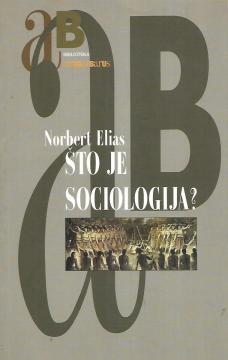
Što je sociologija?

Što je sociologija?

Norbert Elias

A classic work by one of the most influential sociologists of the 20th century, the founder of "figurative" or "process" sociology. The book is a programmatic manifesto against the then dominant structural-functionalist paradigm (Parsons) and pure positiv

Elias elaborates on his key concepts in the book:

  • “figure” (the interdependence of individuals as the basic unit of analysis, not “individual” or “society” as separate instances)
  • “process” – society is not a static state but a long-term, unintentional process (the most famous example: “civilization process”)
  • “social configuration” – a network of interdependencies that shape the behavior of individuals
  • critique of “homo clausus” – the illusion that the individual is a closed box, separated from others

Elias introduces familiar metaphors: society as a dance (four or more people dancing together – there is no dancer without a dance), a game (changing the balance of power changes the rules) and the example of two warring villages that, without intention, create an increasingly complex social structure.

A special chapter is dedicated to “game models” – simple schemes that show how monopolies of power, states and civilizations are born from interdependencies. In the Croatian context, the book has become required reading at universities, as it offers a completely different view of the wars of the 1990s: not as a conflict of "peoples" but as a process of disintegration of long-term interdependencies.

Naslov originala
Was ist Soziologie?
Prevod
Srećko Horvat
Urednik
Rade Kalanj
Dimenzije
24 x 15 cm
Broj strana
162
Izdavač
Antibarbarus, Zagreb, 2007.
 
Latinica. Broširano.
Jezik: Hrvatski.
ISBN
978-9-53249-046-6

Jedan primerak je u ponudi

Stanje:Korišćeno, u odličnom stanju
Dodato u korpu!
 

Zanima Vas i neka druga knjiga? Možete pretražiti našu ponudu pomoću pretrage ili prelistati knjige po kategorijama.

Možda će Vas zanimati i ovi naslovi

Marx u digitalnom dobu: Dijalektički materijalizam na vratima tehnologije

Marx u digitalnom dobu: Dijalektički materijalizam na vratima tehnologije

Katarina Peović-Vuković

Knjiga izlaže marksističku analizu digitalnog doba, gdje tehnologija nije neutralan alat, već proces podložan logici kapitala. Autorica zastupa demokratski socijalizam 21. stoljeća: tehnologiju za potrebe, ne profit.

Durieux, 2016.
Hrvatski. Latinica. Tvrde korice s omotom.
23,58
Juriš u vasionu: Jedna reportaža kroz istoriju čovečjeg leta

Juriš u vasionu: Jedna reportaža kroz istoriju čovečjeg leta

Oto Bihalji-Merin

Fascinantno djelo koje kronološki i umjetnički prati čovjekovu težnju za letom, od mitoloških početaka do modernih postignuća u avijaciji. Autor istražuje kako je ideja letenja oblikovala ljudsku maštu i umjetnost kroz stoljeća.

Nolit, 1936.
Srpski. Latinica. Tvrde korice.
12,34
Kriza, a poslije?

Kriza, a poslije?

Jacques Attali

After A Brief History of the Future, Jacques Attali writes a brief history of the present, dissecting the reasons that led to the first global financial crisis, the ways in which it manifests itself, and possible perspectives for the future.

MeandarMedia, 2009.
Hrvatski. Latinica. Broširano.
9,24
Opća kultura III

Opća kultura III

Nikola Bačić

This is the third part of a series of textbooks that covered basic knowledge from different areas of human creativity, society and civilization.

VISOKA INDUSTRIJSKO-PEDAGOŠKA ŠKOLA U RIJECI, 1971.
Hrvatski. Latinica. Broširano.
8,98
Simbolizam i tumačenje

Simbolizam i tumačenje

Tzvetan Todorov

In seinem Buch untersucht Todorov das Verhältnis zwischen der Produktion von Diskurs (Rhetorik) und seiner Interpretation (Hermeneutik), wobei er sich auf den verbalen Symbolismus konzentriert – das Phänomen der indirekten Bedeutung, die auf der direkten,

Svetovi, 1986.
Srpski. Latinica. Broširano s omotom.
9,54
Internet galaksija: Razmišljanja o internetu, poslovanju i društvu

Internet galaksija: Razmišljanja o internetu, poslovanju i društvu

Manuel Castells

Eine unverzichtbare soziologische Studie von Manuel Castells, dem Autor der Trilogie „Das Informationszeitalter“. Der Titel spielt auf McLuhans „Gutenbergs Galaxis“ an und unterstreicht, dass das Internet eine neue Kommunikationsrevolution darstellt.

Jesenski i Turk, 2003.
Hrvatski. Latinica. Broširano.
11,52