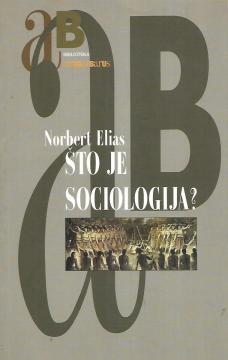
Što je sociologija?

Što je sociologija?

Norbert Elias

A classic work by one of the most influential sociologists of the 20th century, the founder of "figurative" or "process" sociology. The book is a programmatic manifesto against the then dominant structural-functionalist paradigm (Parsons) and pure positiv

Elias elaborates on his key concepts in the book:

  • “figure” (the interdependence of individuals as the basic unit of analysis, not “individual” or “society” as separate instances)
  • “process” – society is not a static state but a long-term, unintentional process (the most famous example: “civilization process”)
  • “social configuration” – a network of interdependencies that shape the behavior of individuals
  • critique of “homo clausus” – the illusion that the individual is a closed box, separated from others

Elias introduces familiar metaphors: society as a dance (four or more people dancing together – there is no dancer without a dance), a game (changing the balance of power changes the rules) and the example of two warring villages that, without intention, create an increasingly complex social structure.

A special chapter is dedicated to “game models” – simple schemes that show how monopolies of power, states and civilizations are born from interdependencies. In the Croatian context, the book has become required reading at universities, as it offers a completely different view of the wars of the 1990s: not as a conflict of "peoples" but as a process of disintegration of long-term interdependencies.

Titel des Originals
Was ist Soziologie?
Übersetzung
Srećko Horvat
Editor
Rade Kalanj
Maße
24 x 15 cm
Seitenzahl
162
Verlag
Antibarbarus, Zagreb, 2007.
 
Latein Schrift. Taschenbuch.
Sprache: Kroatisch.
ISBN
978-9-53249-046-6

Angeboten wird ein Exemplar

Zustand:Gebraucht, in ausgezeichnetem Zustand
Zum Warenkorb hinzugefügt!
 

Interessieren Sie sich für ein anderes Buch? Sie können das Angebot über unsere Suchmaschine suchen und finden oder Bücher nach Kategorien durchsuchen.

Diese Titel könnten Sie auch interessieren

Divlja Evropa

Divlja Evropa

Božidar Jezernik

At the center of Jezernik's scientific work is ethnological and anthropological research of the Balkans and Eastern Europe.

Biblioteka XX vek, 2007.
Serbisch. Latein Schrift. Taschenbuch.
9,98
Guide to Contemporary Culture

Guide to Contemporary Culture

Gene Edward Veith
Inter Varsity Press, 1994.
Englisch. Latein Schrift. Taschenbuch.
6,24
Marx u digitalnom dobu: Dijalektički materijalizam na vratima tehnologije

Marx u digitalnom dobu: Dijalektički materijalizam na vratima tehnologije

Katarina Peović-Vuković

The book presents a Marxist analysis of the digital age, where technology is not a neutral tool, but a process subject to the logic of capital. The author advocates a 21st century democratic socialism: technology for needs, not profit.

Durieux, 2016.
Kroatisch. Latein Schrift. Fester Einband mit Schutzumschlag.
23,5821,22
Rečnik žargona

Rečnik žargona

Dragoslav Andrić
BIGZ, 1976.
Serbisch. Kyrillisch Schrift. Fester Einband mit Schutzumschlag.
32,46
The Abolition Of Liberty: The Decline of Order and Justice in England

The Abolition Of Liberty: The Decline of Order and Justice in England

Peter Hitchens
Radio B92, 2003.
Englisch. Latein Schrift. Taschenbuch.
11,42
Što su Česi?: kratki pregled činjenica i pokušaj objašnjenja

Što su Česi?: kratki pregled činjenica i pokušaj objašnjenja

Jan Patočka

In the book before you, Jan Patočka wrote a paradigmatic essay on the Central European identity of a Slavic people.

Durieux, 2000.
Kroatisch. Latein Schrift. Taschenbuch.
7,746,19