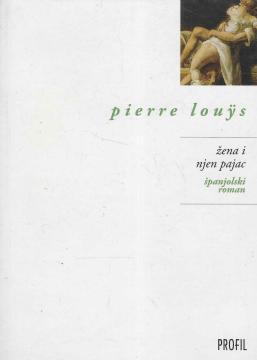
Žena i njen pajac

Žena i njen pajac

Pierre Louÿs

The novel The Woman and Her Clown by Pierre Louÿs tells the passionate story of the beautiful Conchita and her lover André, whose relationship of passion, jealousy, and humiliation shows how love can become a game of power and cruelty.

The Woman and Her Clown (1898) is the most famous work of the French writer Pierre Louÿs, inspired by the Spanish setting and eroticism of the fin de siècle. The novel tells the story of a passionate but destructive relationship between the seductive Spaniard Conchita Pérez and the wealthy Frenchman André Stévens.

At the center of the plot is Conchita – a woman of cold beauty and strong will, who uses love as a weapon. She plays with André’s feelings, alternately offering him tenderness and humiliation. An obsessive relationship develops between them in which love turns into torture and passion into destruction.

Louÿs explores the theme of female power over men, eros as a form of domination and human weakness in the face of desire. Through psychological analysis and an expressive style, the author raises the question: where does love end and addiction begin?

The novel exudes the atmosphere of Andalusia – fiery dance, dark streets and the scent of passion, introducing an exotic tone into the decadent spirit of Parisian literature of the late 19th century.

The work inspired numerous film adaptations, the most famous of which is The Devil Is a Woman (1935) by Josef von Sternberg with Marlene Dietrich in the role of the enigmatic Conchita, and That Obscure Object of Desire (1977) by Luis Buñuel, which interprets the motif of women and dolls in a more modern, symbolic key.

The Woman and her Spider remains a classic story about power, eroticism and humiliation - about love that destroys both the one who loves and the one who rules over love.

Naslov originala
La Femme et le Pantin
Prevod
Marija Paprašarovski
Urednik
Maja Zorica
Dimenzije
18 x 13 cm
Broj strana
146
Izdavač
Profil Knjiga, Zagreb, 2010.
 
Latinica. Broširano.
Jezik: Hrvatski.

Jedan primerak je u ponudi

Stanje:Korišćeno, u vrlo dobrom stanju
Oštećenja / nepogodnosti:
  • Library stamp
Snižena cena: 5,744,02
Popust od 30% važi do 19.06.2026. 23:59
Dodato u korpu!
 

Zanima Vas i neka druga knjiga? Možete pretražiti našu ponudu pomoću pretrage ili prelistati knjige po kategorijama.

Možda će Vas zanimati i ovi naslovi

Neoprezni putnik

Neoprezni putnik

René Barjavel

It could be said that René Barjavel gave new momentum to science fiction and thereby gained the reputation of a modern classic, a recognized predecessor of modern generations of French writers who continue a highly valued tradition.

Jugoslavija, 1979.
Srpski. Latinica. Broširano.
3,98 - 4,76
Talijanske kronike

Talijanske kronike

Marie-Henry Beyle Stendhal

Flipping through old Italian chronicles, Stendhal finds motifs for a series of his novels in which he depicts the passions of the Middle Ages and the unrestrained madness of the Renaissance.

Matica hrvatska, 1948.
Hrvatski. Latinica. Tvrde korice s omotom.
9,368,42
Pričaj im o bitkama, kraljevima i slonovima

Pričaj im o bitkama, kraljevima i slonovima

Mathias Énard

In 1506, Michelangelo Buonarroti was invited by Sultan Bayezid II to design a bridge across the Golden Horn in Constantinople. Furious at Pope Julius II who had humiliated him and refused to pay, Michelangelo left Rome and arrived by ship in Constantinopl

Profil Knjiga, 2012.
Hrvatski. Latinica. Broširano.
7,44 - 7,46
Eugenija Grande

Eugenija Grande

Honore de Balzac

"Eugénie Grandet" (1833), part of Balzac's Human Comedy, is a realistic novel that explores greed, family relationships, and the sacrifices of love in provincial French society.

Svjetlost, 1981.
Hrvatski. Latinica. Tvrde korice.
3,88
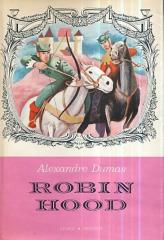
Robin Hood

Robin Hood

Alexandre Dumas

Dumas portrays Robin Hood not only as a bandit who helps the poor, but also as a heroic fighter for justice and a symbol of resistance to feudal injustice.

Epoha, 1966.
Hrvatski. Latinica. Tvrde korice s omotom.
4,26 - 4,82
Evgenija Grande

Evgenija Grande

Honore de Balzac

"Eugénie Grandet" (1833), part of Balzac's Human Comedy, is a realistic novel that explores greed, family relationships, and the sacrifices of love in provincial French society.

Veselin Masleša, 1989.
Hrvatski. Latinica. Tvrde korice.
4,98