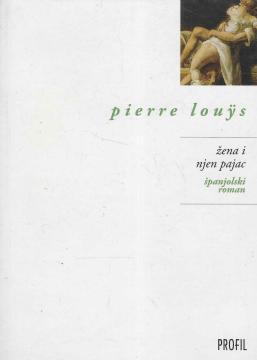
Žena i njen pajac

Žena i njen pajac

Pierre Louÿs

The novel The Woman and Her Clown by Pierre Louÿs tells the passionate story of the beautiful Conchita and her lover André, whose relationship of passion, jealousy, and humiliation shows how love can become a game of power and cruelty.

The Woman and Her Clown (1898) is the most famous work of the French writer Pierre Louÿs, inspired by the Spanish setting and eroticism of the fin de siècle. The novel tells the story of a passionate but destructive relationship between the seductive Spaniard Conchita Pérez and the wealthy Frenchman André Stévens.

At the center of the plot is Conchita – a woman of cold beauty and strong will, who uses love as a weapon. She plays with André’s feelings, alternately offering him tenderness and humiliation. An obsessive relationship develops between them in which love turns into torture and passion into destruction.

Louÿs explores the theme of female power over men, eros as a form of domination and human weakness in the face of desire. Through psychological analysis and an expressive style, the author raises the question: where does love end and addiction begin?

The novel exudes the atmosphere of Andalusia – fiery dance, dark streets and the scent of passion, introducing an exotic tone into the decadent spirit of Parisian literature of the late 19th century.

The work inspired numerous film adaptations, the most famous of which is The Devil Is a Woman (1935) by Josef von Sternberg with Marlene Dietrich in the role of the enigmatic Conchita, and That Obscure Object of Desire (1977) by Luis Buñuel, which interprets the motif of women and dolls in a more modern, symbolic key.

The Woman and her Spider remains a classic story about power, eroticism and humiliation - about love that destroys both the one who loves and the one who rules over love.

Original title
La Femme et le Pantin
Translation
Marija Paprašarovski
Editor
Maja Zorica
Dimensions
18 x 13 cm
Pages
146
Publisher
Profil Knjiga, Zagreb, 2010.
 
Latin alphabet. Paperback.
Language: Croatian.

One copy is available

Condition:Used, very good condition
Damages or inconvenience notice:
  • Library stamp
 

Are you interested in another book? You can search the offer using our search engine or browse books by category.

You may also be interested in these titles

Osječani, gdje ste, da ste: Društvena kronika umirovljenika Lojzeka

Osječani, gdje ste, da ste: Društvena kronika umirovljenika Lojzeka

Alojzije Šmit

In his book Osijekians, where are you, if you were... (1994), Alojzije Šmit presents a humorous and nostalgic social chronicle through the character of the pensioner Lojzek.

Otvoreno sveučilište Osijek, 1994.
Croatian. Latin alphabet. Paperback.
2.46 - 3.98
Rupe u glavi

Rupe u glavi

Vanja Bulić

In the humorous stories from the book Holes in the Head, Vanja Bulić shows sequences from family life and relations between the sexes, in which the humorous aspect and the comedy of situations and confusion dominate.

Laguna, 2021.
Serbian. Latin alphabet. Paperback.
6.82
''O muškarcima''

''O muškarcima''

Zdenka Andrijić
Andrijići.
Croatian. Latin alphabet. Paperback.
3.98
Lucky Jim

Lucky Jim

Kingsley Amis

Regarded by many as the finest, and funniest, comic novel of the twentieth century, Lucky Jim remains as trenchant, withering, and eloquently misanthropic as when it first scandalized readers back in 1954.

Penguin Books Ltd, 1969.
English. Latin alphabet. Paperback.
5.45
Voljeni pokojnik: angloamerička tragedija

Voljeni pokojnik: angloamerička tragedija

Evelyn Waugh
Znanje, 1982.
Croatian. Latin alphabet. Hardcover with dust jacket.
5.12 - 5.14
Stric Josif

Stric Josif

Veikko Huovinen

The book Uncle Joseph (1988) is a satirical collection of 15 stories about the life of Joseph Stalin, written by the Finnish writer and forestry expert (1927–2009) as "memories of a contemporary." The moral of the work is that power corrupts, and satire h

Znanje, 1992.
Croatian. Latin alphabet. Hardcover with dust jacket.
6.545.34 - 7.126.54