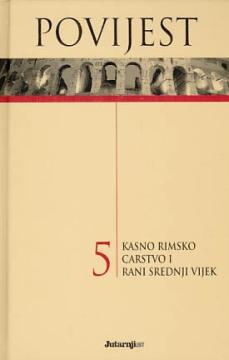
Povijest #5: Kasno Rimsko Carstvo i rani srednji vijek

Povijest #5: Kasno Rimsko Carstvo i rani srednji vijek

The fifth volume covers the final phase in the history of the Roman Empire, the rise of Byzantium and its adoption of the traditions of ancient Rome, as well as the history of Europe after the Great Migration of Peoples. The book ends with the expansion o

Late Roman Empire (284–476): Diocletian (284–305) introduces the tetrarchy, dividing power between two augusti and two caesars to stabilize the Empire in the face of economic crises and barbarian invasions. Constantine the Great (306–337) unifies the Empire, declares Christianity a permitted religion (Edict of Milan, 313), and founds Constantinople. Theodosius I (379–395) declares Christianity the state religion and divides the Empire into Western and Eastern (395). The Western Empire weakens due to internal conflicts, corruption, and barbarian incursions (e.g., Visigoths, Vandals). In 476, Odoacer deposes Romulus Augustulus, marking the end of the Western Empire. The Eastern (Byzantine) Empire continues to exist.

Early Middle Ages (5th–8th centuries): The Early Middle Ages are marked by the creation of barbarian kingdoms in the west (Franks, Ostrogoths, Visigoths). The Frankish kingdom under Clovis (496) adopts Christianity, laying the foundations of European medieval culture. Byzantium under Justinian I (527–565) attempts to rebuild the Roman Empire (conquering Italy, North Africa), but wars exhaust resources. Islam emerges in the 7th century, and the Arabs rapidly expand their rule, conquering parts of Byzantium and Persia. Christianity and Islam shape the cultural and political landscape.

Connections and Legacy: The late Roman Empire transfers legal, administrative, and cultural elements to the Early Middle Ages. Christianity becomes the foundation of European civilization, while Byzantium and Islam shape the Mediterranean.

Naslov originala
Tardo Impero e Alto Medioevo
Prevod
Maja Kuran, Romana Sarić, Nataša Vučić
Urednik
Ivo Goldstein i Enrico Cravetto
Ilustracije
Adom Macheroni
Dimenzije
22 x 14 cm
Broj strana
647
Izdavač
Europapress holding, Zagreb, 2007.
 
Latinica. Tvrde korice.
Jezik: Hrvatski.
ISBN
978-9-53300-039-8

Dva primerka su u ponudi

Primerak broj 1

Stanje:Nekorišćeno
Dodato u korpu!

Primerak broj 2

Stanje:Nekorišćeno
Dodato u korpu!
 

Zanima Vas i neka druga knjiga? Možete pretražiti našu ponudu pomoću pretrage ili prelistati knjige po kategorijama.

Možda će Vas zanimati i ovi naslovi

Povijest #18: Poslijeratno doba (1945.-1985.)

Povijest #18: Poslijeratno doba (1945.-1985.)

Europapress holding, 2008.
Hrvatski. Latinica. Tvrde korice.
11,24
Kratka povijest ljudske rase

Kratka povijest ljudske rase

Michael Cook

Michael A. Cook, Professor für islamische Geschichte an der Princeton University, gibt in dieser geistreichen und intelligenten Synthese einen Überblick über die Menschheitsgeschichte vom Neolithikum bis zum Einsturz der Twin Towers im Jahr 2001 und stell

Profil Knjiga, 2009.
Hrvatski. Latinica. Broširano.
16,2813,02
Zagonetka podunavske civilizacije

Zagonetka podunavske civilizacije

Harald Haarman

Harald Haarmanns Buch präsentiert die Entdeckung der ältesten hochentwickelten Kultur Europas (ca. 5500–3500 v. Chr.), bekannt als Donau- oder Alteuropäische Zivilisation, mit einem Schwerpunkt auf ihrer Schrift, Kunst und ihrem Einfluss.

Akademska knjiga, 2019.
Hrvatski. Latinica. Broširano.
27,00
Otisci bogova: Potraga za početkom i krajem

Otisci bogova: Potraga za početkom i krajem

Graham Hancock

Hancocks Beweise enthüllen nicht nur die deutlichen Spuren einer unbekannten Zivilisation, die während der letzten Eiszeit blühte, sondern auch die erschreckende Wahrheit über das Ausmaß der Katastrophe, die fast alle Spuren davon auslöschte.

Stari grad, 2002.
Hrvatski. Latinica. Tvrde korice.
19,2213,45 - 19,3615,49
Armagedonske bitke: Megido i Jizreelska dolina od Brončanoga do Nuklearnoga doba

Armagedonske bitke: Megido i Jizreelska dolina od Brončanoga do Nuklearnoga doba

Eric H. Cline

Das Buch eines weltbekannten Archäologen und Historikers untersucht Megiddo (hebräisch: Har Megiddo, griechisch: Armageddon) und das Jesreel-Tal als das blutigste Schlachtfeld der Weltgeschichte. Über 4.000 Jahre hinweg wurden in diesem strategisch wichti

Stari grad, 2005.
Hrvatski. Latinica. Tvrde korice.
15,2611,45 - 15,3411,51
Waging War: Conflict, Culture, and Innovation in World History

Waging War: Conflict, Culture, and Innovation in World History

Wayne E. Lee
Oxford University Press, 2015.
Engleski. Latinica. Broširano.
36,22