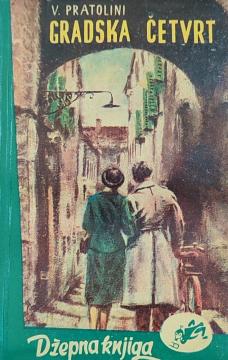
Gradska četvrt

Gradska četvrt

Vasco Pratolini

In Florence, 1932–1939, in the poor neighborhood of Santa Croce, a group of young men go through first loves, fights, friendships, and maturation. Fascism is spreading, but they experience moments of joy and longing in street life, forming an awareness of

"The City District" (written 1943–1944, published 1945) by Vasco Pratolinija is a neorealist novel that depicts the life of young people in the Santa Croce neighborhood of Florence (near Piazza Santa Croce) in the period 1932–1939, that is, during the fascist regime before World War II.

The novel is choral, focused on a group of boys and young men (Valerio, Giorgio, Carlo and others) who pass from adolescence to youth. Pratolini describes their first loves, sexual discoveries, quarrels, friendships and everyday events: street games, dances, walks along the Arno river, visits to the cinema, work in workshops or shops. The neighborhood is almost the main character – alive, full of colors, smells and sounds, but also poverty, cramped apartments and social oppression.

The political context is subtly woven through: fascism is imposed through the demolition of old neighborhoods (as part of the regime's "modernization"), fear, conformity and the beginnings of resistance. The young men gradually come to understand class differences and injustice, but the novel is not agitprop – the emphasis is on humanity, solidarity and the beauty of ordinary life amidst the darkness.

Pratolini uses simple, lyrical language, the technique of chronicle and autobiographical elements (he himself grew up in a similar Florentine neighborhood). The work is part of his early oeuvre (before "Chronicle of Poor Lovers" and the trilogy "Una storia italiana"). A classic of Italian neorealism, praised for its authentic portrayal of working-class youth and subtle criticism of fascism.

Naslov originala
Il Quartiere
Prevod
Nemanja Sjeran
Urednik
Reuf Bravo
Naslovnica
Mirko Stojnić
Dimenzije
17 x 11 cm
Broj strana
157
Izdavač
Džepna knjiga, Sarajevo, 1956.
 
Latinica. Broširano.
Jezik: Srpski.

Jedan primerak je u ponudi

Stanje:Korišćeno, u vrlo dobrom stanju
Oštećenja / nepogodnosti:
  • Traces of patina
Dodato u korpu!
 

Zanima Vas i neka druga knjiga? Možete pretražiti našu ponudu pomoću pretrage ili prelistati knjige po kategorijama.

Možda će Vas zanimati i ovi naslovi

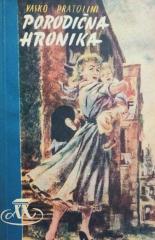
Porodična hronika

Porodična hronika

Vasco Pratolini

The book "Family Chronicle" by Vasco Pratolini is set in Florence, Italy, and follows the life of the Martini family during the period between the two world wars.

Džepna knjiga, 1956.
Hrvatski. Latinica. Broširano.
2,76
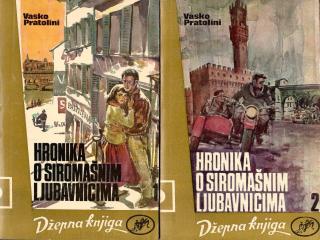
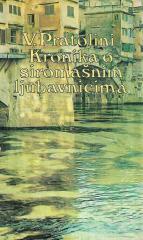
Hronika o siromašnim ljubavnicima

Hronika o siromašnim ljubavnicima

Vasco Pratolini

In Florence 1925–1926, in the poor Via del Corno, the residents live in love, poverty and fear. The arrival of fascism destroys the community: lovers fight, some die from violence, but popular solidarity survives.

Svjetlost, 1966.
Srpski. Latinica. Broširano.
Knjiga se sastoji od dva toma
4,56
Golubovi i jastrebovi

Golubovi i jastrebovi

Grazia Deledda

In a typically Sardinian setting, through a dramatic love story, Deledda depicts the conflict between two families and their worlds – the peaceful, honest "doves" and the aggressive, greedy "hawks".

Hrvatsko književno društvo Sv. Jeronima, 1931.
Hrvatski. Latinica. Tvrde korice.
8,54
Pažnja

Pažnja

Alberto Moravia

Francesco Merighi returns to Rome after 9 years abroad. In order to write an "authentic" novel, he keeps a diary of his life with his wife and their daughter Babe. He obsessively analyzes lies in relationships, the temptation of

Otokar Keršovani, 1966.
Hrvatski. Latinica. Tvrde korice.
3,96
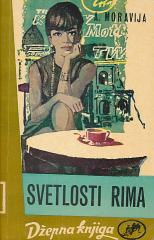
Rimske priče: izbor

Rimske priče: izbor

Alberto Moravia

Collections of short stories from Roman life in the post-war era: ordinary people from the people and the petty bourgeoisie – the poor, workers, small craftsmen – face misery, survival, jealousy, petty deceit and moral compromises in everyday life.

Otokar Keršovani, 1966.
Hrvatski. Latinica. Tvrde korice.
3,98
Djevojka s Leicom

Djevojka s Leicom

Helena Janeczek

The novel is a kaleidoscopic, polyphonic account of the life of Gerda Taro (née Gerda Pohorylle, 1910–1937), the first female war photographer to die on the battlefield. A must-read for fans of historical fiction about strong women and anti-fascism.

Naklada Ljevak, 2020.
Hrvatski. Latinica. Tvrde korice s omotom.
13,72