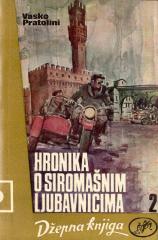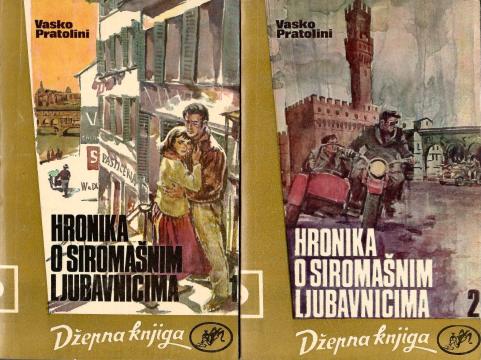
Hronika o siromašnim ljubavnicima

Hronika o siromašnim ljubavnicima

Vasco Pratolini

In Florence 1925–1926, in the poor Via del Corno, the residents live in love, poverty and fear. The arrival of fascism destroys the community: lovers fight, some die from violence, but popular solidarity survives.

“Chronicle of the Poor Lovers” (1947) by Vasco Pratolini is a classic neorealist work of Italian post-war literature. The novel is a choral depiction of life in the Florentine via del Corno – a narrow, poor street near the city center – between 1925 and 1926, during the rise and consolidation of the fascist regime.

The story revolves around the residents of the street (the so-called “cornacchiai”): workers, artisans, small merchants and their families. The main characters are young couples like Mario and Milena (pure, idealistic love), the sensual relationships of Aurora and the coal miner Nesio, and others – Bianca, Clara, Maciste, Ugo. Life is marked by poverty, interconnectedness (everyone knows everything about everyone), loves, quarrels and fear.

Pratolini subtly weaves in the historical context: the rise of fascism brings violence (manganelli, squadristi), blackmail, fear and division. Characters like the fascists Carlin and Osvaldo, the “Signore” (a former courtesan who controls property and collaborates with the regime) or anti-fascists like Maciste illustrate the conflict. The violence culminates in the death of some characters (e.g. Maciste killed by the fascists), the suffering of women and the destruction of balance.

The novel uses the technique of “chronicle” in the historical present, which gives a sense of eternity and immediacy. Without pathos, realistic and lyrical, it depicts the solidarity of the poor, resistance to fascism from below and love as a refuge in darkness. One of the most important works of neorealism, translated into Serbian/Croatian as “Chronicle of Poor Lovers” (e.g. Liber, Zagreb 1982), filmed in 1954 (dir. Carlo Lizzani).

Naslov originala
Cronache di poveri amanti
Prevod
Branka Rakić
Urednik
Risto Trifković
Naslovnica
Mirko Stojnić
Dimenzije
16,5 x 11 cm
Ukupan broj strana
460
Izdavač
Svjetlost, Sarajevo, 1966.
 
Latinica. Broširano.
Jezik: Srpski.

Knjiga se sastoji od dva toma.

Jedan višetomni primerak je u ponudi.
Dodato u korpu!

Hronika o siromašnim ljubavnicima
Prvi tom
Broj strana: 227
Stanje:Nekorišćeno
Hronika o siromašnim ljubavnicima
Drugi tom
Broj strana: 233
Stanje:Nekorišćeno
 

Zanima Vas i neka druga knjiga? Možete pretražiti našu ponudu pomoću pretrage ili prelistati knjige po kategorijama.

Možda će Vas zanimati i ovi naslovi

Gradska četvrt

Gradska četvrt

Vasco Pratolini

In Florence, 1932–1939, in the poor neighborhood of Santa Croce, a group of young men go through first loves, fights, friendships, and maturation. Fascism is spreading, but they experience moments of joy and longing in street life, forming an awareness of

Džepna knjiga, 1956.
Srpski. Latinica. Broširano.
2,48
Porodična hronika

Porodična hronika

Vasco Pratolini

The book "Family Chronicle" by Vasco Pratolini is set in Florence, Italy, and follows the life of the Martini family during the period between the two world wars.

Džepna knjiga, 1956.
Hrvatski. Latinica. Broširano.
2,76
Meštar Don Gesualdo

Meštar Don Gesualdo

Giovanni Verga

Der Roman ist ein wichtiger Vertreter des Verismo, des italienischen Realismus, und schildert das Leben der Menschen aus Süditalien, insbesondere die Konflikte zwischen der armen Bauernschaft und der zerfallenden Aristokratie.

Matica hrvatska, 1947.
Hrvatski. Latinica. Tvrde korice s omotom.
8,42
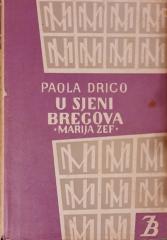
U sjeni bregova

U sjeni bregova

Paola Drigo

Der Roman schildert das tragische Schicksal von Mariuta (Marije Zef) und ihrer jüngeren Schwester Rosuta. Das Werk schockierte die Zeitgenossen durch seine Kühnheit in der Darstellung tabuisierter Themen und gilt heute als Klassiker der Literatur über das

Matica hrvatska, 1961.
Hrvatski. Latinica. Tvrde korice s omotom.
5,32
Ravnodušni ljudi

Ravnodušni ljudi

Alberto Moravia

Der Roman begleitet die verfallende römische Bürgerfamilie von Ardengo über mehrere Tage hinweg: Witwe Mariagrazia, Liebhaber Leo, Sohn Michele und Tochter Carla – alle gefangen in Apathie, Lügen, sexueller Manipulation und moralischer Gleichgültigkeit.

Otokar Keršovani, 1966.
Hrvatski. Latinica. Tvrde korice.
3,22
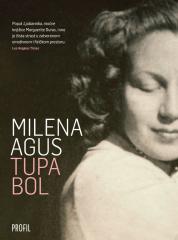
Tupa bol

Tupa bol

Milena Agus

Milena Agus is an award-winning Italian writer. Tupa bol is a novel that brought her international fame, and it was also made into a movie directed by Nicole Garcia and starring Marion Cotillard.

Profil Knjiga, 2019.
Hrvatski. Latinica. Broširano.
5,42