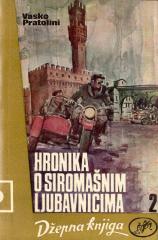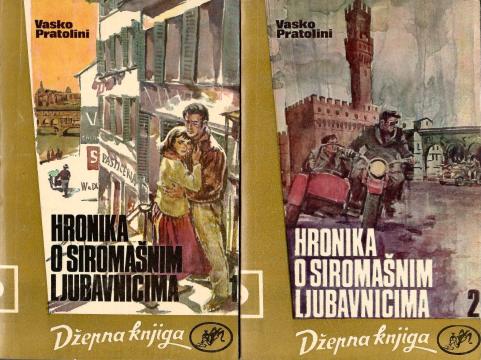
Hronika o siromašnim ljubavnicima

Hronika o siromašnim ljubavnicima

Vasco Pratolini

In Florence 1925–1926, in the poor Via del Corno, the residents live in love, poverty and fear. The arrival of fascism destroys the community: lovers fight, some die from violence, but popular solidarity survives.

“Chronicle of the Poor Lovers” (1947) by Vasco Pratolini is a classic neorealist work of Italian post-war literature. The novel is a choral depiction of life in the Florentine via del Corno – a narrow, poor street near the city center – between 1925 and 1926, during the rise and consolidation of the fascist regime.

The story revolves around the residents of the street (the so-called “cornacchiai”): workers, artisans, small merchants and their families. The main characters are young couples like Mario and Milena (pure, idealistic love), the sensual relationships of Aurora and the coal miner Nesio, and others – Bianca, Clara, Maciste, Ugo. Life is marked by poverty, interconnectedness (everyone knows everything about everyone), loves, quarrels and fear.

Pratolini subtly weaves in the historical context: the rise of fascism brings violence (manganelli, squadristi), blackmail, fear and division. Characters like the fascists Carlin and Osvaldo, the “Signore” (a former courtesan who controls property and collaborates with the regime) or anti-fascists like Maciste illustrate the conflict. The violence culminates in the death of some characters (e.g. Maciste killed by the fascists), the suffering of women and the destruction of balance.

The novel uses the technique of “chronicle” in the historical present, which gives a sense of eternity and immediacy. Without pathos, realistic and lyrical, it depicts the solidarity of the poor, resistance to fascism from below and love as a refuge in darkness. One of the most important works of neorealism, translated into Serbian/Croatian as “Chronicle of Poor Lovers” (e.g. Liber, Zagreb 1982), filmed in 1954 (dir. Carlo Lizzani).

Titel des Originals
Cronache di poveri amanti
Übersetzung
Branka Rakić
Editor
Risto Trifković
Titelseite
Mirko Stojnić
Maße
16,5 x 11 cm
Gesamtzahl der Seiten
460
Verlag
Svjetlost, Sarajevo, 1966.
 
Latein Schrift. Taschenbuch.
Sprache: Serbisch.

Das Buch besteht aus zwei Bänden.

Angeboten wird ein Exemplar.
Zum Warenkorb hinzugefügt!

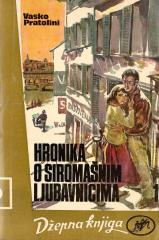
Hronika o siromašnim ljubavnicima
Der erste Band
Seitenzahl: 227
Zustand:Ungebraucht
Hronika o siromašnim ljubavnicima
Der zweite Band
Seitenzahl: 233
Zustand:Ungebraucht
 

Interessieren Sie sich für ein anderes Buch? Sie können das Angebot über unsere Suchmaschine suchen und finden oder Bücher nach Kategorien durchsuchen.

Diese Titel könnten Sie auch interessieren

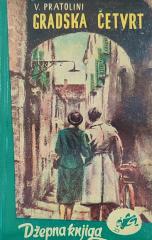
Gradska četvrt

Gradska četvrt

Vasco Pratolini

In Florenz, 1932–1939, erleben junge Männer im Armenviertel Santa Croce erste Liebe, Kämpfe, Freundschaften und das Erwachsenwerden. Der Faschismus breitet sich aus, doch im Straßenleben erfahren sie Momente der Freude und Sehnsucht und entwickeln so ein

Džepna knjiga, 1956.
Serbisch. Latein Schrift. Taschenbuch.
2,48
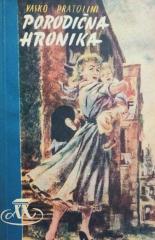
Porodična hronika

Porodična hronika

Vasco Pratolini

Das Buch „Family Chronicle“ von Vasco Pratolini spielt in Florenz, Italien, und verfolgt das Leben der Familie Martini in der Zeit zwischen den beiden Weltkriegen.

Džepna knjiga, 1956.
Kroatisch. Latein Schrift. Taschenbuch.
2,76
Proždrljivac iz tundre

Proždrljivac iz tundre

Anna Maria Bendetti
Školska knjiga, 1969.
Kroatisch. Latein Schrift. Hardcover.
4,48
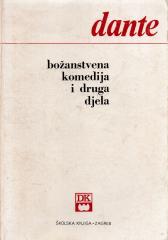
Božanstvena komedija i druga djela

Božanstvena komedija i druga djela

Dante Alighieri

Verschiedene Lieder aus der Göttlichen Komödie wurden im Buch „Göttliche Komödie“ und anderen Werken veröffentlicht. Sowie Werke aus Neuem Leben, Lyrik, Fest, Monarchie, Diskussion „Über die Landessprache“.

Školska knjiga, 1976.
Kroatisch. Latein Schrift. Taschenbuch.
4,50
Nezgode pustinjskog risa

Nezgode pustinjskog risa

Luigi Adami
Školska knjiga, 1969.
Kroatisch. Latein Schrift. Hardcover.
4,48
Tupa bol

Tupa bol

Milena Agus

Milena Agus ist eine preisgekrönte italienische Schriftstellerin. Tupa bol ist ein Roman, der ihr internationalen Ruhm einbrachte, und er wurde auch zu einem Film unter der Regie von Nicole Garcia und mit Marion Cotillard in der Hauptrolle.

Profil Knjiga, 2019.
Kroatisch. Latein Schrift. Taschenbuch.
5,42