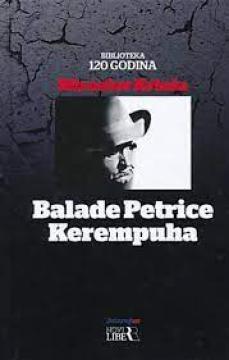
Balade Petrice Kerempuha

Balade Petrice Kerempuha

Miroslav Krleža

Miroslav Krleža's greatest poetic achievement and one of the most important works of Croatian literature. The ballads combine satire, irony, and lyrical-folkloric tones in a condemnation of violence and stupidity of government throughout the centuries.

In Ballads of Petrica Kerempuh, Miroslav Krleža creates a literary work that simultaneously acts as a historical lament, a political indictment, and a poetic fresco of the Croatian north. The main voice of the collection, the fictional Petrica Kerempuh, a folk sage and mocker, observes history “from below”: from the perspective of peasants, serfs, marginalized people, and all those over whom foreign rule has been imposed for centuries.

The collection covers a wide time span — from medieval rebellions and persecutions to the tragedies of the early modern era. Through kajkavština, a language full of rhythm, metaphors, proverbs, and ironic puns, Krleža brings to life the entire world of lost voices: victims of violence, hungry, ridiculed, deceived. Petrica moves through this landscape as a commentator, not submissive, but not naive either — his humor carries the bitterness of experience, and his irony exposes the cruelty of those in power.

In the background of the ballads, the horrors of history unfold: hangings, military campaigns, rebellions, epidemics, robberies and political persecutions. But in this darkness, Krleža also finds motives of resistance — the defiance of the peasant masses, the strength of unity, laughter as the last weapon of those who have no other. The collection thus becomes a chronicle of suffering, but also a testimony to the perseverance of a people who survive thanks to wit and unwavering hope.

Petrica, as a lyrical protagonist, embodies the combination of folk wisdom and literary mask. He sees everything: the emptiness of historical ideologies, the hypocrisy of the authorities, the repetition of tragedies. Krleža uses him to speak about centuries-old injustice, but also to show how the truth is often preserved in the language of mockers and jokes, and not in the speeches of rulers.

Urednik
Slavko Goldstein, Krešimir Nemec
Dimenzije
20 x 13 cm
Broj strana
178
Izdavač
Novi Liber, Zagreb, 2013.
 
Latinica. Tvrde korice.
Jezik: Hrvatski.

Dva primerka su u ponudi

Primerak broj 1

Stanje:Nekorišćeno
Dodato u korpu!

Primerak broj 2

Stanje:Korišćeno, u odličnom stanju
Snižena cena: 7,365,52
Popust od 25% važi do 28.06.2026. 23:59
Dodato u korpu!
 

Zanima Vas i neka druga knjiga? Možete pretražiti našu ponudu pomoću pretrage ili prelistati knjige po kategorijama.

Možda će Vas zanimati i ovi naslovi

Izabrane pjesme

Izabrane pjesme

Miroslav Krleža
Matica hrvatska, 1963.
Hrvatski. Latinica. Tvrde korice s omotom.
9,99
Povratak Filipa Latinovicza

Povratak Filipa Latinovicza

Miroslav Krleža

„Die Rückkehr des Filip Latinovicz“ ist einer der berühmtesten Romane von Miroslav Krleža. Dieser Roman ist in unserer Literatur von Bedeutung, da er als der erste vollständig moderne kroatische Roman gilt.

Večernji list, 2004.
Hrvatski. Latinica. Tvrde korice s omotom.
5,52 - 5,56
Hrvatski bog Mars

Hrvatski bog Mars

Miroslav Krleža

Der kroatische Gott Mars bringt sieben Antikriegsromane hervor, in denen Krleža den Krieg als eine grausame, sinnlose Maschinerie darstellt, die den „kleinen Mann“ zerstört, und die Heuchelei des Militarismus und der Mythen über Heldentum entlarvt.

Rad, 1965.
Srpski. Latinica. Broširano.
1,99
Lirika

Lirika

Ivan Dončević, Ivo Kozarčanin, Anton Nizeteo, Radovan Žilić

Eine seltene Sammlung von Texten von vier jungen kroatischen Dichtern: Dončević (Klonuće), Kozarčanin (Tuga ljeta), Nizeteo (Zelena harpa) und Žilić (Grad na vjetru). Intime, melancholische und landschaftliche Poesie.

Hrvatska revija, 1935.
Hrvatski. Latinica. Broširano.
9,74
Luča mikrokozma

Luča mikrokozma

Petar Petrović-Njegoš

Ein philosophisch-religiöses Gedicht von Petar II. Petrović Njegoš (1845) über die Seele, den Kosmos, den Fall der Engel und das menschliche Schicksal. Der kosmische Flug der Seele und eine biblisch-mythologische Erzählung vom Kampf zwischen Gut und Böse,

Srpska književna zadruga (SKZ), 1923.
Srpski. Ćirilica. Tvrde korice.
7,36
Iz mladih dana: Pjesme izvorne i prevedene

Iz mladih dana: Pjesme izvorne i prevedene

Franjo Marković

Aus den Tagen der Jugend (1883) von Franjo Marković ist eine Sammlung lyrischer Gedichte aus der Jugend dieses prominenten kroatischen Intellektuellen, darunter originelle patriotische und intime Gedichte sowie Übersetzungen von ausländischen Autoren.

Matica hrvatska, 1883.
Hrvatski. Latinica. Broširano.
9,56 - 12,32