Nacionalni testament kralja Aleksandra I
Rijetka knjiga

Nacionalni testament kralja Aleksandra I

Branislav M. Stepanović

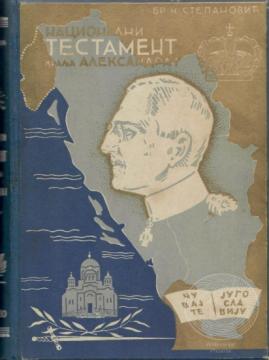
The author presents the political and ideological legacy of King Aleksandar I Karađorđević the Unifier. The book, published immediately after the king's death, is an attempt to preserve and transmit his political ideals to future generations.

King Alexander I was a key figure in the creation of the Kingdom of Serbs, Croats and Slovenes in 1918, and later the Kingdom of Yugoslavia. His vision was to build a unified Yugoslav nation through a policy of "integral Yugoslavism", which sought to overcome ethnic and political divisions within the state. By introducing the January 6th dictatorship in 1929, he dissolved the parliament, banned political parties and assumed absolute power, believing that this was necessary to preserve the unity and stability of the state.

Stepanović's work describes in detail the king's internal struggle, his motives and disappointments, especially in relation to the failure of the policy of Yugoslav unity. The book also presents the king as a tragic figure, whose death in an assassination in Marseille in 1934 symbolically marked the end of an era and the beginning of new challenges for Yugoslavia.

The National Testament of King Alexander I is not only a biography but also a political manifesto that provides insight into the complex processes of building a modern Yugoslav state and the dilemmas it faced.

Ilustracije
Debenjak i Šenšin
Naslovnica
Branislav M. Stepanović
Dimenzije
24 x 18 cm
Broj strana
397
Nakladnik
Jugoslovenska biblioteka "Bratstvo", Beograd, 1936.
 
Ćirilica. Tvrde korice.
Jezik: Srpski.

Jedan primjerak je u ponudi

Stanje:Korišteno, u vrlo dobrom stanju
Oštećenja / nepogodnosti:
  • Damaged back
Dodano u košaricu!
 

Zanima Vas i neka druga knjiga? Možete pretražiti našu ponudu pomoću tražilice ili prelistati knjige po kategorijama.

Možda će Vas zanimati i ovi naslovi

Projekt Guevara: Snovitim stazama svjetske revolucije

Projekt Guevara: Snovitim stazama svjetske revolucije

Gerd Koenen

Dieses Buch ist eine Biografie der historischen Figur und Ikone des 20. Jahrhunderts, Ernesto Che Guevara – im Lichte seines Projekts einer Weltrevolution, die Koenen, in Anlehnung an Bruce Chatwin, Traumwege nennen wird.

Durieux, 2011.
Hrvatski. Latinica. Tvrde korice s ovitkom.
17,6213,22
Adolf Hitler - Führer Trećega Reicha

Adolf Hitler - Führer Trećega Reicha

Joan Solé

In ihrem Buch schildert Joan Solé Leben, Ideologie und Aufstieg Adolf Hitlers. Sie untersucht, wie ein charismatischer, aber fanatischer Führer ein totalitäres Regime formte und die Welt in einen der tragischsten Kriege der Geschichte stürzte.

Twins Company d.o.o., 2025.
Hrvatski. Latinica. Broširano.
8,56
Zaraćeno poraće: Konfliktni i konkurentski narativi o stradanju i iseljavanju Talijana Istre

Zaraćeno poraće: Konfliktni i konkurentski narativi o stradanju i iseljavanju Talijana Istre

Franko Dota

Das Buch analysiert, wie sich nach dem Zweiten Weltkrieg (1943–1956) in Kroatien und Italien widersprüchliche historische Narrative über das Leid und die Massenauswanderung von Italienern aus Istrien und Rijeka entwickelten, entlarvt Mythen und fördert ei

Srednja Europa, 2010.
Hrvatski. Latinica. Broširano.
11,328,49
Sudbonosni podvig Jugoslavije: Podsjećanje na historijsko NE staljinizmu, događaj koji je opredijelio budućnost Jugoslavije

Sudbonosni podvig Jugoslavije: Podsjećanje na historijsko NE staljinizmu, događaj koji je opredijelio budućnost Jugoslavije

Raif Dizdarević

Das Buch von Raif Dizdarević, einem der letzten noch lebenden Akteure der jugoslawischen Diplomatie, präsentiert seine Rekonstruktion des schicksalhaftesten Moments im Nachkriegsjugoslawien – den Bruch mit Stalin und dem Informbüro in den Jahren 1948–1953

Udruženje za modernu historiju (UMHIS), 2018.
Hrvatski. Latinica. Broširano.
23,58
Bormannova braća idu dalje

Bormannova braća idu dalje

William Stevenson

Das Buch enthüllt das geheime Netzwerk, durch das Martin Bormann, Hitlers Schatzmeister, nach dem Fall des Dritten Reiches das Überleben der Nazi-Macht und des Nazi-Kapitals sicherstellte.

Vjesnik, 1977.
Hrvatski. Latinica. Tvrde korice.
6,54
Filozofija revolucije

Filozofija revolucije

Gamal Abdel Nasser

G. A. Nassers Revolutionsphilosophie ist ein politisches Manifest und ideologisches Programm der ägyptischen Revolution von 1952. Darin erläutert Nasser die Motive der Revolution, die Rolle Ägyptens in der arabischen und afrikanischen Welt sowie die Visio

Džepna knjiga, 1956.
Srpski. Latinica. Broširano.
9,56