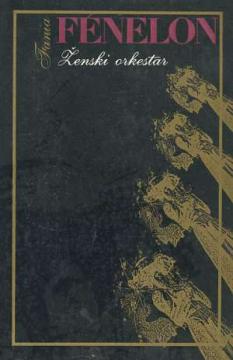
Ženski orkestar
Retka knjiga

Ženski orkestar

Fania Fenelon

Fanie Fénelon's novel The Women's Orchestra is a memoir that describes her experience of surviving in a women's orchestra at the Auschwitz-Birkenau concentration camp during World War II.

Fania, born Fanny Goldstein, a Parisian cabaret singer and member of the Resistance, was arrested in 1943 as a Jew and deported to Auschwitz and later to Bergen-Belsen. In the Birkenau camp, under the number 74862, she joined a women's orchestra led by Alma Rosé, Gustav Mahler's niece.

The orchestra, made up of women of various nationalities, played for the SS and prisoners, often under duress, in order to survive. Fania, a pianist and singer, describes the horrors of the camp - death, humiliation, hunger - but also the dark humor, love, hatred and solidarity among the members of the orchestra. The novel explores moral compromises, tensions between prisoners, including the anti-Semitism of some Polish women, and complex relationships with Nazis, such as Dr. Mengele. Music becomes a means of survival, but also a source of spiritual resistance.

Fénelon writes without pathos, with humor and sincerity, recording trauma and strength of spirit. Although some members of the orchestra, such as Anita Lasker-Wallfisch, challenged her portrayal of Alma Rosé and the dynamics in the orchestra, the work remains a powerful document on the Holocaust, translated into multiple languages and adapted into the film Playing for Time (1980).

Naslov originala
Sursis pour l'orchestre
Prevod
Višnja Machiedo
Urednik
Mirjana Buljan
Dimenzije
20 x 14 cm
Broj strana
372
Izdavač
Globus, Zagreb, 1985.
 
Latinica. Tvrde korice s omotom.
Jezik: Hrvatski.

Jedan primerak je u ponudi

Stanje:Korišćeno, u odličnom stanju
Dodato u korpu!
 

Zanima Vas i neka druga knjiga? Možete pretražiti našu ponudu pomoću pretrage ili prelistati knjige po kategorijama.

Možda će Vas zanimati i ovi naslovi

Djevojčica iz grada

Djevojčica iz grada

Liubov Voronkova

The novel The Girl from the City by Soviet writer Lyubov Voronkova, published in 1942, is a moving story of childhood, survival, and hope during World War II. The work is written in a simple yet emotional style, suitable for younger readers.

A.F.Ž. Hrvatske, 1947.
Hrvatski. Latinica. Broširano.
12,44
Mila 18

Mila 18

Leon Uris

Mila 18 is a novel about the legendary uprising in the Warsaw ghetto. To write the novel, Uris spent years studying archival materials, visiting the places where the events took place and talking to survivors of the ghetto...

Matica hrvatska, 1970.
Hrvatski. Latinica. Tvrde korice s omotom.
7,24
Mačak pod šljemom

Mačak pod šljemom

Joža Horvat

"The Cat in the Helmet" is a novel by Jože Horvat, which carries a strong anti-war message. The plot follows the young sailor Mačko, forced to join the partisan movement during the Second World War.

Naprijed, 1978.
Hrvatski. Latinica. Tvrde korice s omotom.
7,56
Osmi patuljak

Osmi patuljak

Milan Krmpotić
Otokar Keršovani, 1997.
Hrvatski. Latinica. Tvrde korice.
13,32
Susret s Bonapartom

Susret s Bonapartom

Bulat Okudžava

Bulat Okudžava often called his historical novel Meeting with Bonaparte his best work.

Narodna knjiga, 1988.
Srpski. Latinica. Broširano s omotom.
7,46
Jebo sad hiljadu dinara

Jebo sad hiljadu dinara

Boris Dežulović

«Jebo sad hiljadu dinara» - roman čija se radnja događa od zore do sumraka jednog ljetnog dana usred hrvatsko-bošnjaškog rata u Bosni i Hercegovini - još je jedan uzaludan pokušaj istraživanja o besmislu rata. U cijenu uračunat porez na šund.

Europapress holding, 2005.
Hrvatski. Latinica. Broširano.
7,98