Georges Gurvitch
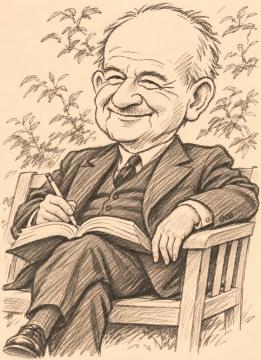
Georges Gurvitch (Novorossiysk, 1894 – Paris, 1965) was a Russian-born French sociologist and legal thinker, originally named Georgy Davidovich Gurvich. His work helped develop the sociology of law and the sociology of knowledge. Trained in law and philosophy, he explored relations between individuals, social groups, institutions and freedom.
After leaving Russia, Gurvitch worked in European academic settings before establishing himself in France. He spent the Second World War in the United States. Following his return, he contributed to the renewal of French sociology and helped establish the Centre d’études sociologiques and Cahiers internationaux de sociologie. He taught at the Sorbonne and the École pratique des hautes études.
Gurvitch understood society as a plural and changing reality that could not be explained through a single principle. He connected the study of immediate social relationships with analyses of groups, classes and entire societies. His method, which he called dialectical hyper-empiricism, challenged rigid theoretical systems and sought to grasp the interdependence and movement of social phenomena.
In L’Idée du droit social (1932), he examined law arising within social communities rather than solely through state legislation. Éléments de sociologie juridique (1940) and Sociology of Law (1942) developed this field further. Major works include La Vocation actuelle de la sociologie (1950), Déterminismes sociaux et liberté humaine (1955) and Dialectique et sociologie (1962). He also edited the two-volume Traité de sociologie (1958–1960).
His interests in legal pluralism, the social conditions of knowledge and human freedom connect the different branches of his scholarship. Gurvitch approached sociology through tensions between established structures and creative human action, insisting on the diversity of collective experience and resisting explanations that reduced society to either individual behaviour or state institutions.
Titel im Angebot
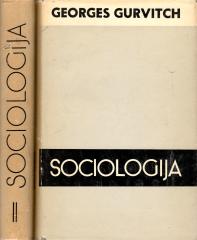
Sociologija I-II
This seminal work by French sociologist Georges Gurvitch systematically presents the theoretical foundations, methods, and branches of sociology, defining social reality through deep-seated layers and total social phenomena.