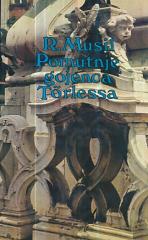
Pomutnje gojenca Torlessa

Pomutnje gojenca Torlessa

Robert Musil

Robert Musil's 1906 novel, set in an elite military boarding school on the edge of the Austro-Hungarian Empire, is a masterpiece by Musil, inspired by the author's own experiences, that anticipates the rise of fascism, mass psychology, and the crisis of m

The protagonist, a sensitive adolescent Törless from a noble family, arrives at this closed institution full of homesickness and inner turmoil. Surrounded by strict rules and a male collective, he faces pubescent confusion, sexual awakening and moral dilemmas.

Törless befriends two fellow students: the ambitious and cruel Reiting and the mystical, occult Beineberg. Together they discover that their colleague Basini is stealing money. Instead of reporting it to the adults, they decide to punish him themselves – starting with blackmail and bullying, which escalates into sadistic torture, physical violence and homosexual abuse in the school attic. Basini, weak and passive, endures everything, becoming a victim of their experiments with power and lust.

Törless, unlike his active friends, remains an observer – deeply introspective, but paralyzed. He is fascinated by Basini’s vulnerability and his own attraction to him, but at the same time repelled by his weakness. He tries to rationalize the violence through philosophical speculations about the difference between reason and irrationality, light and shadow in the soul. Experiences with a local prostitute, Božena, and conversations with a mathematics professor further intensify his "confusions" - a feeling of alienation from the world.

When the violence becomes unbearable, Törless secretly advises Basini to report to the director. An investigation follows: Basini is punished and expelled, while Törless, in a stunning speech about existential emptiness ("things just happen"), impresses the adults with his intellectual depth. They declare him too sensitive for boarding school and send him home for private education. The novel ends with Törless's return, but without a complete solution – only with a deeper knowledge of the hypocrisy of society, suppressed urges and the impossibility of absolute ethics.

Original title
Die verwirrungen des zoglings Torless
Translation
Benjamin Tolić
Dimensions
21 x 13 cm
Pages
157
Publisher
Jutarnji list, Zagreb, 2004.
 
Latin alphabet. Hardcover with dust jacket.
Language: Croatian.
ISBN
9-53-716027-0

One copy is available

Condition:Used, excellent condition
 

Are you interested in another book? You can search the offer using our search engine or browse books by category.

You may also be interested in these titles

Tri žene

Tri žene

Robert Musil
Naprijed, 1986.
Croatian. Latin alphabet. Hardcover with dust jacket.
6.99
Pomutnje gojenca Törlessa / Tri žene

Pomutnje gojenca Törlessa / Tri žene

Robert Musil

Robert Musil's The Confusions of the Young Törless (1906) and Three Women (1924) are works that explore the psychological depths, moral dilemmas, and internal conflicts of the individual, characteristic of Musil's analytical prose.

Sveučilišna naklada Liber (SNL), 1979.
Croatian. Latin alphabet. Hardcover with dust jacket.
5.42 - 6.24
Sakupljač svjetova

Sakupljač svjetova

Ilija Trojanow

A romanticized biography of British adventurer Sir Richard Francis Burton. Three great journeys (India, the Hajj to Mecca, Africa, and the search for the source of the Nile) told from the perspectives of his Indian, Arab, and African companions/guides.

Novela media, 2010.
Croatian. Latin alphabet. Paperback.
12.76
I ne reče ni reči

I ne reče ni reči

Heinrich Böll

In Boll's novels, one of the central themes is the attempt to preserve basic moral values ​​in a time of terror, as well as in a period of material prosperity and corruption.

Svjetlost, 1965.
Serbian. Latin alphabet. Paperback.
3.22 - 3.98
Poezija i zbilja

Poezija i zbilja

Johann Wolfgang Goethe

Goethe's greatest autobiographical prose, written between 1811 and 1833, covers his life from his birth in 1749 in Frankfurt to 1775, when he went to Weimar at the invitation of Duke Karl August.

Matica hrvatska, 1953.
Croatian. Latin alphabet. Hardcover with dust jacket.
18.42
Dnevnici, 1. svezak: 1909-1912.

Dnevnici, 1. svezak: 1909-1912.

Franz Kafka

Kafka's diaries, published posthumously, reveal the inner world of an anxious genius. The first volume covers his early years, when Kafka worked as an insurance clerk in Prague, faced with a dreary life and literary ambitions.

Tim press, 2022.
Croatian. Latin alphabet. Paperback.
15.42