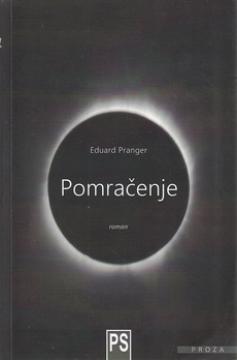
Pomračenje

Pomračenje

Eduard Pranger

Great joys and celebrations, just like shared misfortunes and natural cataclysms, bring people together and teach them to respect the true values ​​of human life: friendship, compassion, helping others, kindness and love.

Solar eclipse. It started exactly at eleven twenty-five on August 11, 1999. The moon, four hundred times smaller than the sun, was swallowing and covering the mighty lord of our sky more and more every minute. The shadows grew sharper, and the leaves on the trees cast clear sickle outlines on the ground. About ten minutes later, the bright summer day was replaced by dusk. A cold, sharp wind suddenly blew through the until then completely calm treetops, and it also stopped. All movements stopped and nature became speechless. The birds fell silent, the animals calmed down, and the people, amazed by the sight, looked at the sky. The sun's corona was spilling over the dark Moon, and along the very edge one could see the red glow of powerful protuberances. Darkness reigned, and the gray-blue sky revealed for a few moments the bright Venus and Mercury.

It lasted about half a minute, maybe a full minute, and then a shadow appeared in the southwestern part of the horizon. Although there was not a single cloud, it looked as if some terrible storm was coming and suddenly, the first ray of light flashed through the stark, atmosphereless lunar horizon. It happened suddenly. A flock of pigeons flew over the treetops, and the chirping of birds marked the end of that short, but magnificent and terrifying event. The noise of cars and the shouting of children in the nearby park could be heard again, and the warmth of the Sun brought back the hot summer. Painfully reminding us how small and powerless we really are, who and what we are in relation to the endless expanses of the Universe, the grandiose show of Nature ended.

Editor
Kemal Mujičić
Graphics design
Ivica Drljača
Dimensions
20.5 x 13.5 cm
Pages
195
Publisher
Poezija subotom, Zagreb, 2020.
 
Latin alphabet. Paperback.
Language: Croatian.
ISBN
978-9-53486-915-4

One copy is available

Condition:Used, excellent condition
 

Are you interested in another book? You can search the offer using our search engine or browse books by category.

You may also be interested in these titles

Žuti vrtuljak

Žuti vrtuljak

Drago Hedl

The Yellow Carousel by Drago Hedl is a picture book intended for children, but it carries a universal message about imagination, freedom and the joy of life. Set in Osijek, the story follows a boy who discovers a magical yellow carousel on the banks of th

Galerija likovnih umjetnosti, 1985.
Croatian. Latin alphabet. Hardcover.
3.50 - 3.80
Izlet na Kras

Izlet na Kras

Milan Sokić

The trip to the Karst is a small episode in the hero's life, but it perfectly revives the spirit of the turn of the century that is best characterized by Hans Driesch, a scientist, future philosopher, and founder of vitalism.

Fraktura, 2017.
Croatian. Latin alphabet. Hardcover with dust jacket.
6.64
Glad na ledini

Glad na ledini

Agustin Stipčević
Zora, 1968.
Croatian. Latin alphabet. Hardcover with dust jacket.
5.22
Polagana predaja

Polagana predaja

Goran Tribuson

"Slow Handover" provides an insight into the spirit of the times and the challenges faced by the generation in transition.

Leo Commerce, 2001.
Croatian. Latin alphabet. Hardcover with dust jacket.
8.18
Hrvatske narodne pjesme, knjiga deseta: Haremske pričalice i bunjevačke groktalice

Hrvatske narodne pjesme, knjiga deseta: Haremske pričalice i bunjevačke groktalice

The tenth book in the Croatian Folk Songs series, subtitled Women's Songs – Volume Six: Harem Tales and Bunjevac Groktalice, represents a valuable contribution to the preservation and study of Croatian oral literature.

Matica hrvatska, 1942.
Croatian. Latin alphabet. Hardcover.
12.349.87
Sabrana djela VII: Jelena, žena koje nema: pripovetke

Sabrana djela VII: Jelena, žena koje nema: pripovetke

It is a collection of short stories by Ivo Andrić, which was first published in 1963. This collection contains a number of short stories that explore existential themes, and the title story is one of the most famous in Andrić's oeuvre.

Mladost, 1967.
Serbian. Latin alphabet. Hardcover.
8.56