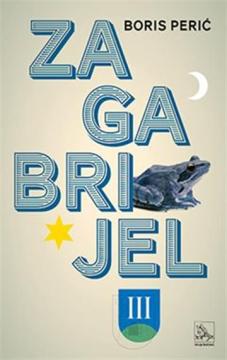
Zagabrijel

Zagabrijel

Boris Perić

The third part brings to an end this painful and dark story in which the unfortunate Nesi Hensu, better known as the Zagreb mummy, will find herself involved, neither guilty nor obliged.

With Zagabrije, the first part of this unusual trilogy, Boris Perić attracted the readership by creating a skilfully told criminal story, in which an old Zagreb secret society with nefarious intentions, a passer-by, a linguist and professor Vollmeyer who is in Zagreb for a professional conference, become involved, inspector Orešković, a policeman who cannot wait for his hard-earned pension, an employee of Zagreb's Čistoca, a certain Stjepan Mrak aka Kmica, and Lukrecija Panj, a young journalist of an unnamed large media company who is the first to notice that something really strange is happening in Zagreb. Our heroes found themselves in a truly ungrateful position after they were imprisoned in the basement of the national library by a cannibal-gourmand, with their fate and that of the entire city uncertain, which slowly fell under the influence of the dark Zagabriel, the fallen angel and protector of bribery and corruption. The third part of Perić's trilogy brings us the escape of the marten from the coat of arms to Ireland, inspector Orešković finally finds the answer to the Sphinx's riddle that haunts him in his dreams, and alongside our inspector who is impatiently awaiting retirement, the brave Štef Kmica and prof. Vollmeyer are dealing with an influential apparatus, a mysterious device that has put the Croatian metropolis under the rule of the sinister Zagreb.

Editor
Josip Ivanović
Graphics design
Iva Mandić
Dimensions
20 x 13 cm
Pages
145
Publisher
Edicije Božičević, Zagreb, 2022.
 
Latin alphabet. Paperback.
Language: Croatian.
ISBN
978-9-53362-025-1

One copy is available

Condition:Used, excellent condition
 

Are you interested in another book? You can search the offer using our search engine or browse books by category.

You may also be interested in these titles

Deobe 1-3

Deobe 1-3

Dobrica Ćosić

This work, awarded the NIN Prize for that year, is considered one of the most significant in Serbian literature after World War II.

Prosveta, 1961.
Serbian. Cyrillic alphabet. Hardcover with dust jacket.
The book consists of 3 volumes
11.42
Knjiga moga oca

Knjiga moga oca

Ethem Mandić

This is a biography about my father made up of memories and mere imagination. History does not exist, and neither do facts. The past is unknown.

OKF d.o.o, 2016.
Croatian. Latin alphabet. Paperback.
10.64
I ne reče ni reči

I ne reče ni reči

Heinrich Böll

In Boll's novels, one of the central themes is the attempt to preserve basic moral values ​​in a time of terror, as well as in a period of material prosperity and corruption.

Svjetlost, 1965.
Serbian. Latin alphabet. Paperback.
3.22 - 3.98
Osuđen na uspjeh

Osuđen na uspjeh

Hans Hellmut Kirst

In this work, the character of police inspector Keller appears for the first time, who fights crime with unusual methods.

Prosveta, 1987.
Croatian. Latin alphabet. Paperback.
4.983.49
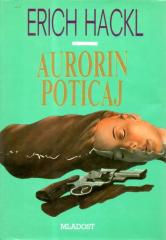
Aurorin poticaj

Aurorin poticaj

Erich Hackl

The work is based on a true event that occurred in Spain in 1933: Aurora Rodriguez killed her daughter Hildegart, a famous fighter for women's emancipation and a cult figure on the political scene of the time.

Mladost, 1990.
Croatian. Latin alphabet. Hardcover with dust jacket.
4.96 - 4.98
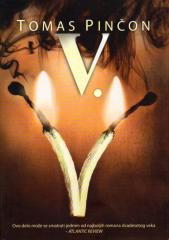
V.

V.

Thomas Pynchon

The novel represents a journey into an alternative world – a world that we all belong to from time to time, but of which we would not want to be a part, a world of paranoia and alienation that we are not entirely sure is just an alternative or the bare tr

Čarobna knjiga, 2010.
Serbian. Latin alphabet. Paperback.
21.9816.49