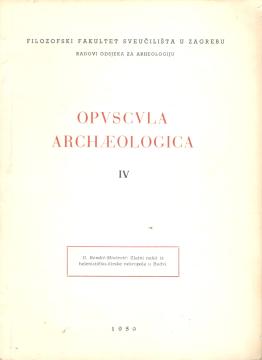
Opuscula archaeologica IV: Zlatni nakit iz helenističko-ilirske nekropole u Budvi
Der Artikel präsentiert eine klassische Analyse archäologischer Funde aus der hellenistischen Zeit (3.-2. Jahrhundert v. Chr.) in der Nekropole nördlich des antiken Budva (heutiges Montenegro), die in den 1950er Jahren entdeckt wurden.
Der Autor katalogisiert und beschreibt detailliert den Goldschmuck aus 12 Gräbern: Spiralarmbänder in Schlangenform aus dünnem Goldblech (Gewicht 10–20 g), Ohrringe mit Pyramidenmuster (umgedrehte Pyramiden mit granulierten Verzierungen), runde zoomorphe Ohrringe mit Löwen- und Stiermotiven, Fibeln, Ringe mit Intaglio und Ketten mit Anhängern. Er analysiert die Verarbeitungstechniken (Schmieden, Filigranarbeit, Granulation), Stile (hellenistische Einflüsse mit illyrischen Varianten) und den Kontext: Der Schmuck wurde in Frauen- und Männergräbern mit Keramik, Bronze und Eisen gefunden, was auf elitäre Bestattungsrituale hindeutet. Rendić-Miočević vergleicht ihn mit parallelen Funden aus Glasinac, Trebenište und griechischen Zentren und datiert sie in die makedonische Phase des Hellenismus.
Diese Objekte mit einem Gesamtgewicht von über 200 g sind seltene Beispiele für hochwertigen Goldschatz im illyrischen Raum und zeugen vom Reichtum der lokalen Stämme (wahrscheinlich der Doclea oder Labeati). Die Motive (Schlangen als Schutzsymbol, zoomorphe Elemente) zeigen eine Synthese griechischer Einflüsse und autochthoner Symbolik, und die Qualität der Verarbeitung weist auf Meister aus Makedonien oder Epirus hin. Die Funde bestätigen Budva als wichtiges Handels- und Kulturzentrum an der Adria.
Das Werk bereichert das Bild der illyrischen Zivilisation und veranschaulicht die hellenistische Akkulturation auf dem Balkan: die Verbreitung griechischer Kunst durch Handel und Migration, soziale Hierarchie (Schmuck als Statussymbol) und ethnische Interaktionen. Als eine der ersten detaillierten Studien über illyrisches Gold beeinflusste sie spätere Forschungen (z. B. in Trebenište, Apollonia) und trug zur Rekonstruktion der Balkanrouten und des Übergangs von der Eisenzeit zur hellenistischen Zeit bei. Sie bleibt ein Referenzwerk zum Verständnis der vorrömischen adriatischen und illyrisch-griechischen Verbindungen.
Jedan primerak je u ponudi