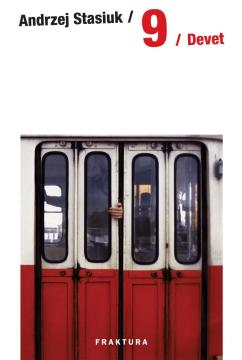
Devet

Devet

Andrzej Stasiuk

“Nine” (1999) by Andrzej Stasiuk, one of the most important contemporary Polish writers, is an unusual thriller that follows a small shopkeeper, Paweł, a modern-day Ulysses, whose life changes abruptly when debt collectors rob him and destroy his apartmen

In three days of wandering through the divided Warsaw of the late 1990s – from the bright to the dark side of the city – Paweł seeks salvation, meeting nine characters, from criminals, drug addicts, to ordinary girls and men. Through their stories, he experiences betrayals, fights, unrealized sexual adventures and profound symbolic encounters that reveal the chaos of post-communist Poland.

Stasiuk, born in 1960 in Warsaw, a former deserter and prisoner, lives in the Carpathians where he runs the Czarne publishing house. In “Nine” he combines pathos with lyricism, sarcasm with artistry, creating a poetic labyrinth of urban existence. The novel depicts a generation freed from ideology, but lost in alienation from family, neighbors and friends, more clearly than any study. Warsaw becomes Joyce’s Dublin – a metaphysical space of marginalized souls, where lust, violence and the melancholy of transition collide.

It ends abruptly, without resolution, without victory or defeat, leaving the reader in suspense. Praised for its linguistic sophistication and provocativeness, "Nine" is one of the best novels of the nineties, a bridge between European tradition and contemporary nightmare.

Original title
Dziewięć
Translation
Ivana Maslač
Editor
Seid Serdarević
Graphics design
Ana Baletić
Dimensions
20 x 14 cm
Pages
257
Publisher
Fraktura, Zaprešić, 2003.
 
Latin alphabet. Paperback.
Language: Croatian.

One copy is available

Condition:Used, excellent condition
Damages or inconvenience notice:
  • Traces of patina
 

Are you interested in another book? You can search the offer using our search engine or browse books by category.

You may also be interested in these titles

Ljudi sa kamena

Ljudi sa kamena

Dušan Đurović
Svjetlost, 1964.
Croatian. Latin alphabet. Paperback.
3.44
Zbogom oružje

Zbogom oružje

Ernest Hemingway

Hemingway's novel A Farewell to Arms (1929), set on the Italo-Austrian front, follows the love story and wartime experiences of Frederic Henry, an American lieutenant who serves as an ambulance driver in the Italian army during World War I.

Mladost, 1952.
Croatian. Latin alphabet. Paperback.
1.00 - 6.50
Pravo jačega

Pravo jačega

Gert Ledig
Svjetlost, 1961.
Croatian. Latin alphabet. Paperback.
3.98
Elizabeth Costello

Elizabeth Costello

John Maxwell Coetzee

Elizabeth tirelessly lectures and gives speeches all over the world. Although it is not entirely clear in this work where fiction ends and fiction begins, the character of Elizabeth is a metaphor for a writer who does not write but gives formal speeches.

VBZ, 2007.
Croatian. Latin alphabet. Hardcover.
5.28
Kako sam preživjela

Kako sam preživjela

Doris Lessing

The novel How I Survived (1974) by Doris Lessing is a dystopian novel that follows the unnamed narrator, a middle-aged woman, in a futuristic city collapsing due to social and economic collapse.

Globus, 1985.
Croatian. Latin alphabet. Hardcover with dust jacket.
5.784.88 - 6.505.78
Rat u ogledalu

Rat u ogledalu

John Le Carre

John le Carré's fourth spy novel, which depicts the intelligence struggle during the Cold War in an ironic and pessimistic way. The novel deconstructs the romantic image of secret agents by showing the decay and illusions of the old British intelligence g

Grafički zavod Hrvatske (GZH), 1990.
Croatian. Latin alphabet. Paperback.
3.32