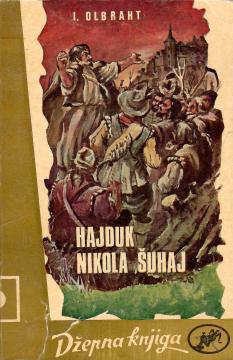
Hajduk Nikola Šuhaj
Rare book

Hajduk Nikola Šuhaj

Ivan Olbracht

Hajduk Nikola Šuhaj (1933) is the most famous novel by Ivan Olbracht (real name Kamil Zeman, 1882–1952), a classic of 20th-century Czech literature. One of the most important works of Czech literature between the two wars.

The novel is set in Subcarpathian Russia (today Ukraine, Transcarpathian Oblast) after World War I and the collapse of Austria-Hungary. The main character Nikola Šuhaj, a young peasant from the village of Kolochava, returns from the front. Due to poverty, injustice from landowners and the authorities, and the impossibility of a normal life, he becomes a hajduk – a bandit. He begins to rob rich Jews, merchants and Chetniks, but distributes the money to poor peasants, which makes him a folk hero and the Robin Hood of the Carpathians.

Olbracht subtly depicts social contrasts: the poverty of the Ruthenian peasants, corruption of the authorities, anti-Semitism and exploitation. Nikola is not idealized – he is brave, but also violent, and his life is full of danger. The novel culminates in betrayal: in 1921, his comrades kill him for a reward, and his head is cut off and displayed as a trophy.

The style is realistic with elements of folk legend and ballad: the author uses folklore motifs, dialectal expressions and an epic tone, creating a myth about a righteous bandit. The work is anti-war and socially critical, but without agitation - the emphasis is on the tragic fate of the individual in the chaos of post-war society.

The novel was a great success, was screened several times (eg the movie "Nikola Šuhaj loupežník" in 1978, directed by Jiří Sequens), and became part of the folk mythology of Transcarpathia. In Yugoslavia, it was popular in post-war editions, appreciated for its humanism and realistic portrayal of peasant life.

Original title
Nikola Šuhaj loupežník
Translation
Zora Simić
Editor
Risto Trifković
Graphics design
Mirko Stojnić
Dimensions
16.5 x 11 cm
Pages
213
Publisher
Svjetlost, Sarajevo, 1965.
 
Latin alphabet. Paperback.
Language: Croatian.

One copy is available

Condition:Unused
 

Are you interested in another book? You can search the offer using our search engine or browse books by category.

You may also be interested in these titles

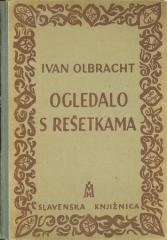
Ogledalo s rešetkama

Ogledalo s rešetkama

Ivan Olbracht

"Mirror with bars" by Ivan Olbracht is a novel that deals with the themes of identity, love and social norms through the story of the life and internal conflicts of the main character, Milan. (Author's real name: Kamil Zeman.)

Matica hrvatska, 1946.
Croatian. Latin alphabet. Hardcover.
2.99 - 4.76
Smrt u Breslauu

Smrt u Breslauu

Marek Krajewski

The novel Death in Breslau is a first-rate historical crime thriller, and Eberhard Mock is already a classic figure in world literature. The first part of the series – a dark, atmospheric, brutally realistic depiction of pre-war Germany.

Fraktura, 2009.
Croatian. Latin alphabet. Paperback.
12.34
Zaboravljene djevojke

Zaboravljene djevojke

Martha Hall Kelly

The novel The Forgotten Girl is based on the real life of a member of New York's posh circles, who fought for the rights of Kunić, a group of women who survived the horrors of the Ravensbrück concentration camp.

Mozaik knjiga, 2018.
Croatian. Latin alphabet. Paperback.
7.98
Kleopatra: Egipatska kraljica

Kleopatra: Egipatska kraljica

Claude Ferval

The novel tells the lavish story of the last Egyptian queen, a woman of exceptional intelligence and beauty, whose life, love affairs with Caesar and Antony, and tragic death symbolize the collision of power, passion, and fate.

Alfa, 1985.
Croatian. Latin alphabet. Hardcover with dust jacket.
8.34
Lukrecija Borgia – Lijepa vojvotkinja

Lukrecija Borgia – Lijepa vojvotkinja

Johannes Burcardus

The novel about Lucrezia Borgia was written according to the records of Bishop Burcardus, chamberlain of Pope Alexander VI.

Alfa, 1985.
Croatian. Latin alphabet. Hardcover with dust jacket.
4.98
Tri mušketira 1-2

Tri mušketira 1-2

Alexandre Dumas

Dumas' version of the story depicts the adventures of d'Artagnan and his friends from 1625 to 1628.

Epoha, 1966.
Croatian. Latin alphabet. Hardcover with dust jacket.
The book consists of two volumes
9.48