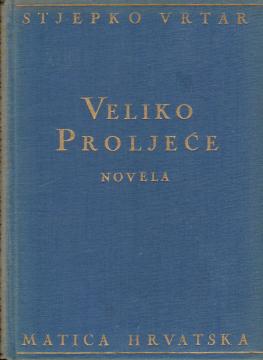
Veliko proljeće
Antique
Rare book

Veliko proljeće

Stjepko Vrtar

The Great Spring (1933) depicts the awakening and rebirth of the Croatian village and the common man in the interwar period – a symbolic depiction of the national and social spring, the peasant movement, and the personal maturation of the main character.

1,341 Stjepko Vrtar (1890–1945?), a Croatian writer and financial expert, activist of the Peasant Unity, published the novella Veliko proljeće in 1933, published by Matica hrvatska (Naklada Pramatice). The work belongs to the socially engaged prose of the interwar period with emphasized folk and peasant motifs.

The novella depicts the awakening of the Croatian people in the 1930s through the fate of a young peasant or intellectual from the village. The author describes difficult living conditions, poverty, political pressure and the national question, but also hope for a better tomorrow – the “great spring” as a metaphor for national revival, the strengthening of the peasant movement (HSS) and spiritual awakening. Vrtar combines a realistic depiction of rural life with lyrical and idealistic passages, emphasizing the themes of justice, education, solidarity and love for the land and people.

The style is accessible, warm and engaged, typical of literature close to the Peasant Unity. The work exudes optimism and faith in the strength of the common man, despite the difficult social conditions of the Kingdom of Yugoslavia. Critics have noted the authenticity in the depiction of the rural mentality and social problems.

The Great Spring is a relatively rare antiquarian edition and represents an interesting example of the literature of the Croatian peasant movement in the interwar period. Today it is read as a document of the times and a testimony to the national and social hopes of the 1930s.

Dimensions
20 x 14 cm
Pages
100
Publisher
Matica hrvatska, Zagreb, 1933.
 
Latin alphabet. Hardcover.
Language: Croatian.

One copy is available

Condition:Used, excellent condition
 

Are you interested in another book? You can search the offer using our search engine or browse books by category.

You may also be interested in these titles

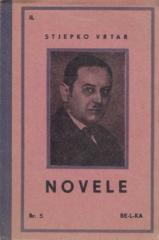
Novele

Novele

Stjepko Vrtar
Minerva nakladna knjižara, 1943.
Croatian. Latin alphabet. Paperback.
5.323.72
Ljudi ispod Osojnika

Ljudi ispod Osojnika

France Bevk

"People Below Osojnik" is a novel by Slovenian writer France Bevko, published in 1934. The work is known for its realistic depiction of peasant life on the Slovenian coast during the first half of the 20th century.

Spektar, 1974.
Croatian. Latin alphabet. Hardcover.
3.62
I ne reče ni reči

I ne reče ni reči

Heinrich Böll

In Boll's novels, one of the central themes is the attempt to preserve basic moral values ​​in a time of terror, as well as in a period of material prosperity and corruption.

Svjetlost, 1965.
Serbian. Latin alphabet. Paperback.
3.22 - 3.98
Baselska zvona

Baselska zvona

Louis Aragon

The novel follows three women: Diane, a noblewoman; Catherine Simonidzé, a feminist; and the real Clara Zetkin, a communist. Through their destinies, the crisis of bourgeois society, women's emancipation, and the path to communism are depicted.

Kultura, 1946.
Serbian. Latin alphabet. Hardcover.
5.76
Ravnodušni ljudi

Ravnodušni ljudi

Alberto Moravia

The novel follows the declining Roman bourgeois family of Ardengo over the course of several days: widow Mariagrazia, lover Leo, son Michele, and daughter Carla – all trapped in apathy, lies, sexual manipulation, and moral indifference.

Otokar Keršovani, 1966.
Croatian. Latin alphabet. Hardcover.
3.22 - 3.86
Mati

Mati

Maksim Gorki

Maxim Gorky's novel "Mother" was published in 1906 and is one of the key works of Russian social realism. The work depicts the awakening of the working class in Russia through characters and events that emphasize social injustices and the need for revolut

Svjetlost, 1975.
Croatian. Latin alphabet. Hardcover.
4.26