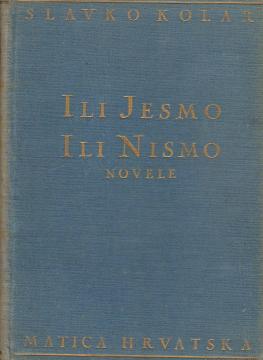
Ili jesmo ili nismo
Either We Are or We Are Not (1933) is Slavko Kolar's most famous collection of short stories. With a satirical and warm sense of humor, Kolar depicts the life of the Croatian village and the common man in interwar Yugoslavia – electoral fraud, bureaucracy
Slavko Kolar (1891–1963) published a collection of short stories Ili jesmo ili nismo in 1933, published by Matica hrvatska in Zagreb. This is his first major collection and one of the most successful achievements of Croatian humorous and satirical prose of the 20th century.
The collection contains several interconnected short stories and stories in which Kolar masterfully depicts the everyday life of the Croatian village and the small town dweller. In addition to the title short story Ili jesmo ili nismo, the collection also contains the short stories Ptica nebeska, Politička večera, Kompromis and Žljiva. Through humorous situations and lively dialogues, the author depicts political fraud in elections, corruption, bureaucratic absurdities, poverty and the cunning of peasants trying to get by in difficult times.
Kolar's humor is mild but sharp. Behind the laughter often lies deep social criticism and compassion for the common man. His peasants are not idealized – they are cunning, sometimes selfish, but always human. He is particularly successful in capturing rural speech, mentality and atmosphere.
The collection was a great success immediately upon publication and established Kolar as the leading Croatian humorous storyteller. It is considered a classic of Croatian interwar prose and one of the best depictions of rural life in Croatian literature.
The style is lively, dynamic and extremely readable. Kolar combines realism with irony and gentle lyricism, creating prose that is at once entertaining and deeply humane. Either We Are or We Are remains one of Kolar's most widely read and successful works, and some stories (especially the title story) have become anthologies.
One copy is available