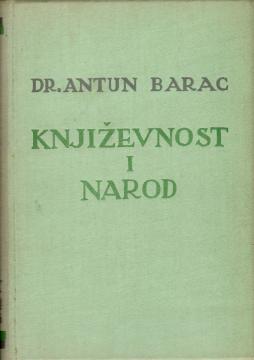
Književnost i narod: Rasprave i eseji
Literature and the People: Discussions and Essays is a collection of literary and historical studies by Antun Barc on the Croatian Renaissance, realism and peasant themes, and the relationship of literature to society and national consciousness.
Literature and the People: Discourses and Essays, published in 1941, is one of the most significant collections of literary-historical and critical works by Antun Barac, a leading Croatian literary historian and university professor. The book brings together studies written over several years, linked by the common theme of the relationship between literature and the people, social changes and the formation of Croatian cultural identity.
The content includes the discussions Literary Concepts of the Illyrians, Literature on Preradović, The Entry of the Village into Recent Croatian Literature, The Social Background of Perkovac's Stories, The Village in the Works of Croatian Realists, Šimunović and Criticism and Literary Parallels. In them, Barac explores the development of Croatian literary thought from the Illyrian movement to modernity, analyzing how writers reflected the needs, ideals and living circumstances of Croatian society.
The author pays special attention to the depiction of villages and peasantry in Croatian literature. It shows how the village gradually established itself as an important literary theme during the 19th century and how Croatian realists and storytellers sought to faithfully portray social relations, economic circumstances, and the everyday life of the Croatian peasant. In his studies of Mirko Bogović, Ivan Perkovac, and Dinko Šimunović, Barac connects literary works with their social and historical background, emphasizing that literature is not only an aesthetic phenomenon but also a document of the times.
The discussions on the Illyrians and Petar Preradović shed light on the role of literature in shaping national consciousness during the Croatian Renaissance, while the concluding essays provide comparisons of literary phenomena and authors in a broader European context. The work is a valuable example of Barac's method of connecting literary analysis, cultural history, and social interpretation, and represents an important contribution to 20th-century Croatian literary historiography.
One copy is available