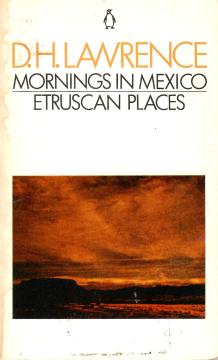
Mornings in Mexico / Etruscan Places
Two masterpieces of travel prose in which D. H. Lawrence records encounters with Mexican nature and Native American rituals, as well as Etruscan tombs and art, contrasting them with modern mechanical civilization.
This combined book by D. H. Lawrence offers two of his most famous travelogue cycles that form a whole in his search for “living life.” Mornings in Mexico (1927) was born from Lawrence’s stays in Mexico and New Mexico in the 1920s, while Etruscan Places (1932) is his last major work, written during a trip to Etruria in 1927, shortly before his death.
In Mornings in Mexico, Lawrence paints mornings in Oaxaca and the surrounding area with poetic precision. He describes lively markets, parrots, Indian dances (such as the “Dance of the Sprouting Corn”), customs, and the natives’ relationship to nature and time. It is not a classic travelogue with historical facts, but a deeply personal, sensual experience. Lawrence senses the “dark” vitality of the Indian world—a combination of beauty and brutality, purity and darkness—which contrasts with white, industrial civilization. He is critical of Spanish heritage and modernization, and fascinated by the rhythm of nature and the body that is not yet alienated from the land. His style is impressionistic: colors, smells, movements and inner restlessness merge into hypnotic prose.
Etruscan Places is even more intimate and philosophical. Lawrence visits Cerveteri, Tarquinia, Vulci and Volterra, enters painted tombs and reads Etruscan art as a message of life. He sees the Etruscans as a people who celebrated the body, sexuality, fertility and the joy of existence, in contrast to the Roman imperial violence and the fascist Italy of Mussolini's era that he encounters in the background. For him, the tombs are not places of death, but sanctuaries of life – frescoes with dancers, animals and feasts show the "free, bold and fresh" spirit that modern man has lost. Lawrence develops his philosophy here: a critique of mechanized Europe, a praise of pagan vitality and a belief in renewal through contact with the ancients. The book is at once a travelogue, an art criticism and a spiritual testament.
Both works are linked by Lawrence’s obsession with “flesh and blood” as opposed to spirit and machine. In Mexico he searches for a living primitive force, in Etruria – its lost but still legible traces in art. His style is rich, sometimes eccentric, always passionate: the landscape, people and artifacts become symbols of the inner state of Europe and humanity itself. The reader does not receive objective information, but Lawrence’s subjective fervor – a mixture of admiration, nostalgia and anger towards modernity.
This combined book is ideal for fans of travelogues that transcend genre and become philosophical meditations. Lawrence does not just describe places – he experiences them, criticizes civilization and calls for a return to the roots of physical and spiritual freedom. The work is fresh, provocative and poetically powerful even today.
One copy is available