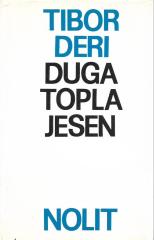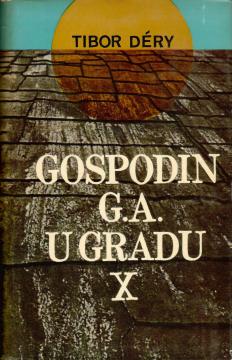
Gospodin G.A. u gradu X
Mr. G.A. in the City of X by Tibor Déry is a Kafkaesque dystopia about a man who arrives in a perfect city where everything is permitted, but precisely because of that, nothing has meaning or value anymore.
Mr. G.A. in the City of X (1964) is one of the most significant works of the Hungarian writer Tibor Déry (1894–1977). The novel was written in prison, where the author was imprisoned for participating in the Hungarian Revolution of 1956, and is considered the pinnacle of his late oeuvre and an excellent satire on totalitarian societies.
The main character, Mr. G.A., arrives in the mysterious city of X – a seemingly ideally arranged place where complete freedom reigns. Residents can do whatever they want, there are no prohibitions, no scarcity, no coercion. But it is precisely this absolute freedom that leads to absurdity: without restrictions, meaning, motivation and the true joy of life also disappear. The city becomes a place of spiritual emptiness, boredom and dehumanization. Déry masterfully shows how utopia in practice becomes dystopia.
The novel is strongly Kafkaesque: an atmosphere of misunderstanding, bureaucratic absurdity and a sense of being trapped within a seemingly free system permeate the entire work. Déry uses irony, grotesque and philosophical depth to criticize not only the socialist system of his time, but also more broadly – any ideology that promises perfection. Many have seen the novel as a mirror of real socialism, but the work has universal value and is read today as a criticism of contemporary consumerism and “freedom” in which everything is permitted and nothing else matters.
The style is elegant, precise and introspective. Déry does not offer simple answers, but asks deep questions about the nature of freedom, happiness, the meaning of existence and the limits of human community. The novel is extremely dense – every sentence carries a multi-layered meaning.
Mr. G.A. in the city of X is a masterpiece of 20th-century Hungarian literature and an outstanding example of intellectual prose that combines literary value with sharp social criticism.
One copy is available