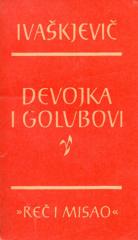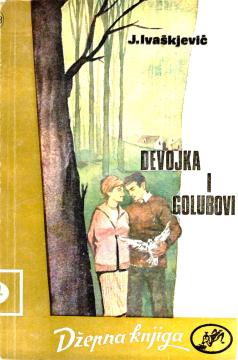
Devojka i golubovi

Devojka i golubovi

Jaroslaw Iwaszkiewicz

Young Edek lives with his elderly father who tries to keep his son by his side. The boy's longing for freedom and a girl clashes with his father's possessiveness. The pigeons symbolize unattainable freedom. The conflict leads to a tragic ending.

“The Girl and the Pigeons” is one of the most famous stories by Jaroslav Iwaśkiewicz (1894–1980), published in 1955 in the magazine “Twórczość”. The story takes place in post-war Poland (probably the 1950s), in a family home where a father – a lonely engineer-architect – lives with his younger son Edek. The father, aware of his own old age and fear of loneliness, unconsciously becomes possessive of his son, wanting to keep him with him as long as possible. Edek, a young man in the process of maturing, feels an increasing inner longing for freedom, love and independence – embodied in the image of a girl and symbolically in the pigeons flying freely above the house.

Iwaśkiewicz subtly builds a psychological conflict: the father does not realize how much he is stifling his son, and the son cannot express his rebelliousness without feeling guilty. The pigeons – the birds that the boy watches and feeds – become a metaphor for unattainable freedom, youthful longing and transience. The story culminates in a tragic clash of generations: the father feels that “tragedy is approaching” and that life will take his son away from him, while Edek tries to break free from this emotional trap.

The story is a classic example of Iwaśkiewicz’s style: lyrical, introspective, with a deep dive into the human psyche, subtle symbolism and a sense of melancholic inevitability. There is no pathos, but a quiet but powerful drama of family relationships and the transience of life. The story was based on the 1973/74 TV film “Dziewczyna i gołębie” (dir. Barbara Sass) starring Jadwiga Jankowska-Cieślak and Andrzej Seweryn.

Original title
Dziewczyna i gołębie
Translation
Petar Vujičić
Editor
Risto Trifković
Graphics design
Mirko Stojnić
Dimensions
16.5 x 11 cm
Pages
235
Publisher
Svjetlost, Sarajevo, 1965.
 
Latin alphabet. Paperback.
Language: Croatian.

One copy is available

Condition:Unused
 

Are you interested in another book? You can search the offer using our search engine or browse books by category.

You may also be interested in these titles

Devojka i golubovi, Mlin na kamjoni

Devojka i golubovi, Mlin na kamjoni

Jaroslaw Iwaszkiewicz
Rad, 1964.
Serbian. Latin alphabet. Paperback.
0.99
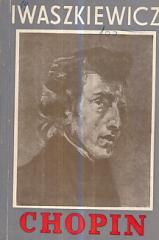
Chopin

Chopin

Jaroslaw Iwaszkiewicz
Nakladni zavod Hrvatske, 1949.
Croatian. Latin alphabet. Paperback.
1.00 - 2.00
Za novim putem: novele

Za novim putem: novele

August Cesarec

"Za novi putem" is a collection of novels by Augusto Cesarco, originally published in 1919. This work is characteristic of his early creative period, marked by modernist aspirations and social sensitivity.

Matica hrvatska, 1926.
Croatian. Latin alphabet. Paperback.
7.62
Crno proljeće / Svijet seksa

Crno proljeće / Svijet seksa

Henry Miller

Black Spring is a collection of essays and short stories by the American writer Henry Miller, which was first published in 1936. "The World of Sex" is Miller's second well-known work, which is particularly controversial due to its explicit content.

Otokar Keršovani, 1967.
Croatian. Latin alphabet. Hardcover.
6.48 - 8.36
Sabrana djela X: Staze, lica, predeli

Sabrana djela X: Staze, lica, predeli

Ivo Andrić

"Paths, faces, landscapes" is a collection of essays and writings by Ivo Andrić, first published in 1963. This work differs from Andrić's fiction because it deals with philosophical, introspective and autobiographical considerations.

Mladost, 1967.
Serbian. Latin alphabet. Hardcover.
5.864.40
Izgubljeni zavičaj / Dolutali metak

Izgubljeni zavičaj / Dolutali metak

Slobodan Novak

A short novel or a longer story, Izgubljeni zavičaj (1955), established Novak as one of the most important writers of Croatian existentialism.

Zora, 1969.
Croatian. Latin alphabet. Hardcover with dust jacket.
7.125.34