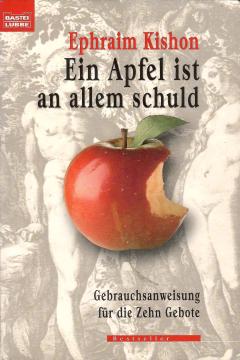
Ein Apfel ist an allem schuld

Ein Apfel ist an allem schuld

Ephraim Kishon

Kishon satirizes the Ten Commandments in a series of short stories. Human weaknesses, hypocrisy and futile attempts to live a consistent life according to the law are the source of comedy. The title alludes to the apple of Eden.

Ein Apfel ist an allem schuld is a humorous retelling of the Ten Commandments, translated from Hebrew into German by the author himself, along with Ursula Abrahamy and Friedrich Torberg. Kishon calls the Bible “a unique, wonderful work that transcends human comprehension,” but approaches it with the same merciless but warm satirical gift he has for all human institutions. Each commandment is given its own cycle of stories: the first on the devaluing of idols and telephone gods, the third on a chaotic holiday and a “fishnet stocking carnival,” the fifth on a series of misunderstood murders, the seventh on petty daily theft as a common folk sport, the eighth on professional false witness, the ninth on neighborly envy and squaring the circle.

The title alludes to the apple of Eden—the fruit that, according to the biblical story, causes man to fall into sin; but Kishon twists this motif: the fault lies not in the apple or in the Creator, but in the eternal human clumsiness to interpret even the clearest commandment in a way that suits it. A special charm is given by the final vignette in which the "apple worm" himself makes a defense speech against Kishon's accusation — how no one has ever so decisively shifted the blame to the apple. The pinnacle of Kishon's satirical biblical journalism, extremely popular in the German-speaking world.

Translation
Ephraim Kishon, Ursula Abrahamy, Friedrich Torberg
Dimensions
18.5 x 12.5 cm
Pages
397
Publisher
Bastei Lübbe, Köln, 1998.
 
Latin alphabet. Paperback.
Language: German.

One copy is available

Condition:Unused
 

Are you interested in another book? You can search the offer using our search engine or browse books by category.

You may also be interested in these titles

Blefsikon: Menedžment

Blefsikon: Menedžment

John Courtis
Mladinska knjiga, 1994.
Croatian. Latin alphabet. Paperback.
2.46
Što je muškarac bez brkova: humoristički roman

Što je muškarac bez brkova: humoristički roman

Ante Tomić

When it was first published in 2000, Tomić's novel What is a Man Without a Mustache instantly became a bestseller, and over the next few years it went through a series of new editions, dramatizations, and a film adaptation. First edition.

Hena Com, 2000.
Croatian. Latin alphabet. Paperback.
15.24
Pripovijetke

Pripovijetke

Nikolaj Vasiljevič Gogolj

A classic Croatian edition with a selection of the most famous stories by Gogol - a master storyteller who combines humor, the grotesque, fantasy, and deep social satire.

Kultura, 1950.
Croatian. Latin alphabet. Hardcover.
9.52
Vezana

Vezana

Lauren Henderson

Mistakenly kidnapped and tied to a ceiling beam, Sam Jones tries to remember her special love adventure. The painful blows, along with her innate humor, will encourage the heroine to focus all her peace of mind on solving life's problems.

Škorpion, 2002.
Croatian. Latin alphabet. Hardcover.
7.36
Nema slonova u Meksiku

Nema slonova u Meksiku

Zoran Pilić

These stories will make us laugh, but also imperceptibly take us to the other, dark side...

Fraktura, 2014.
Croatian. Latin alphabet. Hardcover with dust jacket.
6.985.58
Gradić gdje je vrijeme stalo

Gradić gdje je vrijeme stalo

Bohumil Hrabal

Bohumil Hrabal, a Czech writer known for his lyrical grotesque and humor, in his novel The Town Where Time Stood Still evokes childhood in the small town of Libeň (part of Prague), where time seems to stand still in a magical but melancholic world.

Hena Com, 2006.
Croatian. Latin alphabet. Paperback.
7.626.10