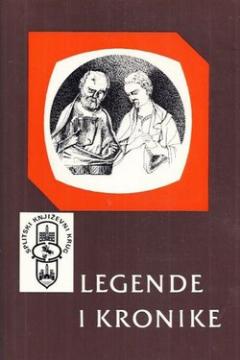
Legende i kronike
"Legends and Chronicles" is a collection of invaluable texts from the Middle Ages and the Modern Age, dedicated to the legends and chronicles of Trogir, Split and Brač. A rare antiquarian treasure, it reminds us of the magic of Dalmatia where legends nour
The legends and chronicles of Trogir, Split and Brač, created over a period of several centuries, in addition to the data that are of great historical importance for the reconstruction of the history of this area, each carry within itself the unadulterated spirit of the times in which they were formed. Gligo (1939–2011), a Split essayist and literary critic, author of "Memories of Marina" and "Croatian Mythology", and Morović, historian and editor, have collected texts that reconstruct local history through the spirit of the times: from saints and miracles to everyday records about islands and cities under Venetian and Croatian rule.
The book is divided into two parts: the first with editorial transcriptions, the second with manuscript facsimiles. Legends include the "History of St. Dujem and Staš" (mystical visions of the Trogir Cathedral), the "Life of St. John of Trogir" (a story of martyrdom and miracles from the 12th century) and the "Life of St. Arnir" (a legend about the Bishop of Split). Chronicles include: Miha Madijev de Barbazanis "History" (Trogir notaries from the 16th century), A. Cutheis "Tabula" (genealogical records), Dujam Hranković "Description of Fr. Brač" (geographical and customs from the 17th century) and Vicko Prodić "Chronicle of Fr. Brač" (Italian original, translated by Josip Posedel, about Brač clans and seafaring). Quote from the legend: "St. John, seeing the city in flames in a dream, cried out: 'Trogir, save yourself from the fire of sin!'"
Topics: the mixture of pagan and Christian, the identity of the Dalmatian region, resistance to invaders and the preservation of tradition. As a source for historians (e.g. in works on the Trogir Cathedral), the book emphasizes the Chakavian language and local patriotism, influencing contemporary Croatian regional literature. In the context of the 1970s, a symbol of resistance to oblivion: "Chronicles are not just paper, but the voice of the people against time."
One copy is available