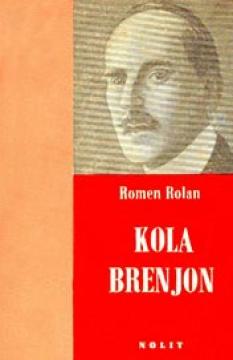
Kola Brenjon

Kola Brenjon

Romain Rolland

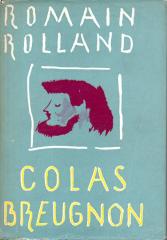
In this work, written during World War I, Rolland contrasts the destructive hatred with the joy of life, humor, and solidarity. Kola is a kind of Burgundian Falstaff or Rabelais' Gargantua – rough but noble, earthly but deeply humane.

Burgundy, 1616. Kola Brenjon, a cheerful, plump carpenter and carver from the small town of Clamecy, tells us his life in the first person. Although he is over 60 years old, he is full of joy of life, loves good wine, women, jokes and his craft. The book is actually his diary through one turbulent year.

Kola loves freedom and his homeland, but hates hypocrisy, fanaticism and tyranny. When wars come to Burgundy (the Thirty Years' War is just knocking on the door), plague and religious conflicts between Catholics and Huguenots, Kola remains true to himself: he helps both, ridicules all those who pretend to be important and enjoys life even when his house burns down and his friends die.

Despite suffering, illness and death, Kola Brenjon remains a symbol of unwavering optimism and the French "joie de vivre". In the end, seriously ill with the plague, he nevertheless recovers and celebrates life with the words: "I am alive! I am alive! It is good to be alive!"

Original title
Colas Breugnon
Translation
Milan Bogdanović
Illustrations
Sreten Grujić
Graphics design
Lj. Pavičević Fis
Dimensions
17 x 12 cm
Pages
225
Publisher
Nolit, Beograd, 1966.
 
Latin alphabet. Hardcover.
Language: Serbian.

One copy is available

Condition:Used, excellent condition
 

Are you interested in another book? You can search the offer using our search engine or browse books by category.

You may also be interested in these titles

Colas Breugnon

Colas Breugnon

Romain Rolland

"Colas Breugnon" is a charming romance of life in Burgundy three hundred years ago. It is an "autobiographical" novel, the story being told in the first person by Colas, who reviews his fifty years of life, and describes all its joys and sorrows.

Zora, 1952.
Croatian. Latin alphabet. Hardcover with dust jacket.
2.99
Petar i Lucija

Petar i Lucija

Romain Rolland
Zora, 1951.
Croatian. Latin alphabet. Paperback.
4.98
Pažnja

Pažnja

Alberto Moravia

Francesco Merighi returns to Rome after 9 years abroad. In order to write an "authentic" novel, he keeps a diary of his life with his wife and their daughter Babe. He obsessively analyzes lies in relationships, the temptation of

Otokar Keršovani, 1966.
Croatian. Latin alphabet. Hardcover.
3.96
Kuća na obali

Kuća na obali

Daphne Du Maurier

Du Maurier masterfully blends sci-fi, the gothic atmosphere of Cornwall, and psychological drama – about addiction, escape from reality, identity, and the value of nostalgia. A tense and introspective novel, with an emphasis on how the past can be more da

Nakladni zavod Matice hrvatske, 1977.
Croatian. Latin alphabet. Hardcover with dust jacket.
5.36
Svjetlost se ugasila

Svjetlost se ugasila

Rudyard Kipling

The first novel by English Nobel Prize winner Rudyard Kipling (1865–1936), first published in Lippincott's Monthly Magazine (happy ending variant), and then in a book version with a tragic ending.

Zora, 1957.
Croatian. Latin alphabet. Hardcover with dust jacket.
5.42
Budenbrokovi

Budenbrokovi

Thomas Mann

The Buddenbrooks is not just a family chronicle – it is a profound, melancholic fresco of how time and change inexorably creep into the core of a respectable bourgeois family, bringing with them a downfall that is both tragic and inevitable.

Svjetlost, 1961.
Serbian. Latin alphabet. Hardcover.
The book consists of two volumes
11.54