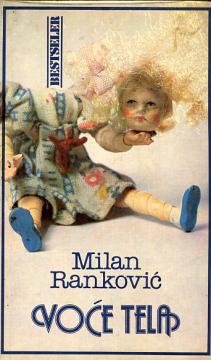
Voće tela

Voće tela

Milan Ranković

"Fruits of the Body" (1983) is a novel by Milan Ranković that explores physicality as a source of pleasure, suffering and social interaction in the context of Yugoslav socialism. The novel remains an under-read gem of Yugoslav prose in the 1980s.

The main character, a middle-aged intellectual and aesthetician like the author himself, leads us through an introspective search for the meaning of physical existence. Through a series of fragments and monologues, Ranković examines the "fruits of the body" – metaphorically the fruits of bodily experiences: love affairs, parenthood, illness and artistic inspiration.

The plot, structured in a labyrinth, moves between Belgrade and Zagreb, where the protagonist encounters former lovers, colleagues and anonymous encounters that reveal the contrasts between the idealized aesthetics of the body in art and the harsh reality of everyday life. In one key segment, the character is confronted by a young artist who accuses him of compromising with the body in favor of ideology, triggering a deep self-reflection on sexuality as resistance to the system.

The novel emphasizes Ranković's background as an art theorist – influences from Kafka to Barthes – criticizing the repression of the body under socialism and celebrating its sensuality. The style is fragmentary, poetic, full of allegories (the body as a garden, the fruit as sin and reward), with doses of humor and irony towards bureaucratic Yugoslavia. As part of Ranković's late phase, the work connects his earlier essays on aesthetics with fiction, leaving the reader with the question: is the body the fruit or the burden of freedom?

Editor
Zdravko Židovec
Graphics design
Nenad Dogan
Dimensions
20 x 15 cm
Pages
218
Publisher
August Cesarec, Zagreb, 1983.
 
Latin alphabet. Hardcover with dust jacket.
Language: Croatian.

Two copies are available

Copy number 1

Condition:Used, excellent condition

Copy number 2

Condition:Used, excellent condition
 

Are you interested in another book? You can search the offer using our search engine or browse books by category.

You may also be interested in these titles

V.

V.

Thomas Pynchon

The novel represents a journey into an alternative world – a world that we all belong to from time to time, but of which we would not want to be a part, a world of paranoia and alienation that we are not entirely sure is just an alternative or the bare tr

Čarobna knjiga, 2010.
Serbian. Latin alphabet. Paperback.
21.98
Zagrepčanka

Zagrepčanka

Branislav Glumac

Branislav Glumac published a novel without periods or commas in 1974, as the relentless stream of thought of a young rebel. Published in socialist Yugoslavia, the work caused a scandal with its openness and became a classic about generational rebellion.

IROS, 1986.
Croatian. Latin alphabet. Hardcover.
8.24
Made in U.S.A.

Made in U.S.A.

Goran Tribuson

Imagine Zagreb in the 1980s, where behind the gray facades of apartment buildings lies a dream world of the far West – Hollywood, freedom and endless possibilities. Tribuson, a master of Croatian prose, here combines genres into one fluid story that bites

Znanje, 1986.
Croatian. Latin alphabet. Hardcover with dust jacket.
5.72
I ne reče ni reči

I ne reče ni reči

Heinrich Böll

In Boll's novels, one of the central themes is the attempt to preserve basic moral values ​​in a time of terror, as well as in a period of material prosperity and corruption.

Svjetlost, 1965.
Serbian. Latin alphabet. Paperback.
3.22 - 3.98
Knjiga moga oca

Knjiga moga oca

Ethem Mandić

This is a biography about my father made up of memories and mere imagination. History does not exist, and neither do facts. The past is unknown.

OKF d.o.o, 2016.
Croatian. Latin alphabet. Paperback.
10.647.98
Dok ležah na samrti

Dok ležah na samrti

William Faulkner

Faulkner's 1930 novel, a classic example of modernist literature. It is often compared to Joyce's "Ulysses" for its innovative structure, but is more accessible due to its focus on family.

Rad, 1985.
Croatian. Latin alphabet. Paperback.
3.26