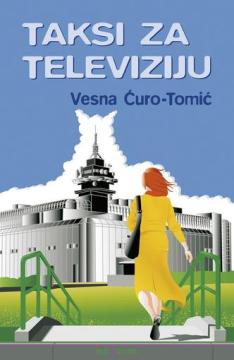
Taksi za televiziju

Taksi za televiziju

Vesna Ćuro-Tomić

Nika Gracijani lives in a world that is much more grown up, more serious and less witty than her. Among people who are incomparably better armed in the fight for survival. As a tapir among tigers, lions and most of all coyotes...

Instead of writing an engaging novel, with the character of a heroine and a sufferer, Vesna wrote a book in which the main character is just very confused. Although it houses everything.

A number of parallel stories run through Taxi for Television. One is a family story, the other is a story about childhood, and the third is about life and work at Croatian Television.

Every now and then the fourth gets involved, the husband appears who has read what was written and shares some very strange and cheerful praises and remarks.

Nika lives with her family in Velika Mlaka. Their house is ugly and dark, so it is difficult to revive it with his attention. She has never cooked the same dish twice, she likes to clean up the least, but she likes everything to be in its place.

Between the images of daily life in Zagreb, memories of childhood on the outskirts of Sarajevo, which was just about to grow up and adorn itself with neon, line up.

Nika has been working at Croatian Television for twenty years. Even in that world of bureaucracy, scheming, walking icons, angry Croatian vigilantes and faces who are always on the side of the winner - it doesn't matter if it's about war or ordering coffee - he doesn't do well.

Vesna turned a series of banal scenes into a beautiful, charming and almost tender literary text. It would be said that God gave her the naivety necessary for the building on Prisavlje to be treated as a literary fact. She says that she has always written, but never showed it to anyone.

She thinks that writing is the only talent she has, but not enough to be a writer. This is of course not true, but it sounds good.

Editor
Neven Antičević
Illustrations
Nenad Martić
Dimensions
25 x 17 cm
Pages
697
Publisher
Algoritam, Zagreb, 2004.
 
Latin alphabet. Hardcover.
Language: Croatian.
ISBN
978-9-53220-175-8

One copy is available

Condition:Unused
 

Are you interested in another book? You can search the offer using our search engine or browse books by category.

You may also be interested in these titles

Lice iza ogledala

Lice iza ogledala

Vesna Ćuro-Tomić
24 sata, 2017.
Croatian. Latin alphabet. Paperback.
9.287.42
Proces

Proces

Franz Kafka

Kafka wrote The Process between 1914 and 1915, published posthumously in 1925. The novel is unfinished but with an added final chapter by Max Brod. Edition with a foreword by B. Živojinović and an afterword by Walter Killi.

BIGZ, 1990.
Serbian. Latin alphabet. Paperback.
4.26
Pripovetke iz levog i desnog džepa

Pripovetke iz levog i desnog džepa

Karel Čapek

These stories deal with different topics, although most deal with different criminal acts, from fraud and fortune-telling to marriage fraud and murder.

Jugoslavijapublik, 1980.
Croatian. Latin alphabet. Hardcover.
5.22
Zagrepčanka

Zagrepčanka

Branislav Glumac

Branislav Glumac published a novel without periods or commas in 1974, as the relentless stream of thought of a young rebel. Published in socialist Yugoslavia, the work caused a scandal with its openness and became a classic about generational rebellion.

IROS, 1986.
Croatian. Latin alphabet. Hardcover.
8.24
Krčma

Krčma

Julian Stryjkowski

The book "Inn" by Julian Stryjkowski, published in 1977, explores life in a small Jewish village in Galicia during the 19th century.

BIGZ, 1977.
Serbian. Latin alphabet. Paperback.
4.38
Deobe

Deobe

Dobrica Ćosić

Deobe is a novel about the tragic division of Serbs into Chetniks and Partisans during World War II. Winner of the NIN Award, it is part of a wider epic trilogy, inspired by Ćosić's experiences and historical documents.

Prosveta, 1963.
Croatian. Latin alphabet. Hardcover with dust jacket.
13.74