Stari obiteljski vrt

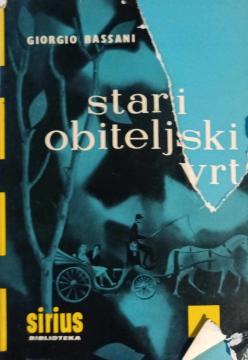
Stari obiteljski vrt

Giorgio Bassani

Giorgio Bassani's Italian historical novel, published in 1962, chronicles the relationship between the narrator and the children of the Finzi-Contini family from the rise of Benito Mussolini to the beginning of World War II.

The wealthy Jewish Finzi-Contini family, both in life and death, is separated from the rest of the world and difficult to enter. Their children are taught privately, and they spend their days playing tennis on a court located in the middle of a beautiful garden that is difficult to see, let alone enter, due to a high fence. The narrator, also Jewish, but less wealthy, falls in love with Micol Finzi-Contini, the rich man's darling, who is older than him and, just like the family garden, distant, unattainable and mysterious. Their love story, which consists mostly of longing, anticipation of meeting and waiting for the phone to ring, is one of the most beautiful ever written. Family tragedies, the increasingly ominous arrival of Nazism will afford the main character only moments of closeness with his love, moments that he will remember for the rest of his life.

Original title
Il giardino dei Finzi - Contini
Translation
Jerka Belan
Editor
Oto Šolc
Graphics design
Milan Vulpe
Dimensions
20 x 14 cm
Pages
234
Publisher
Mladost, Zagreb, 1964.
 
Latin alphabet. Hardcover with dust jacket.
Language: Croatian.

Two copies are available

Copy number 1

Condition:Used, very good condition
Damages or inconvenience notice:
  • Damaged book cover

Copy number 2

Condition:Used, very good condition
Damages or inconvenience notice:
  • Traces of patina
  • Damaged book cover
 

Are you interested in another book? You can search the offer using our search engine or browse books by category.

You may also be interested in these titles

Deobe

Deobe

Dobrica Ćosić

Deobe is a novel about the tragic division of Serbs into Chetniks and Partisans during World War II. Winner of the NIN Award, it is part of a wider epic trilogy, inspired by Ćosić's experiences and historical documents.

Prosveta, 1963.
Croatian. Latin alphabet. Hardcover with dust jacket.
13.74
Ulazeći u Varcar

Ulazeći u Varcar

Ivan Lovrenović

The hybrid book – a novel, poem and essay in one – is a dedication to his native Varcar, a small village in central Bosnia, where the author's roots intertwine with the history, myth and chaos of the 20th century.

Fraktura, 2016.
Croatian. Latin alphabet. Hardcover with dust jacket.
14.4212.98
Deobe 1-3

Deobe 1-3

Dobrica Ćosić

This work, awarded the NIN Prize for that year, is considered one of the most significant in Serbian literature after World War II.

Prosveta, 1961.
Serbian. Cyrillic alphabet. Hardcover with dust jacket.
The book consists of 3 volumes
11.42
Crna kutija

Crna kutija

Amos Oz

The Black Box is a kaleidoscope of married life and love relationships. It is a novel that implicitly speaks about all of us.

Hena Com, 2001.
Croatian. Latin alphabet. Hardcover.
10.98
Usta puna zemlje

Usta puna zemlje

Branimir Šćepanović

The novel "Usta puna zemlje" (1970), the masterpiece of the Serbian writer Branimir Šćepanović, is a psychologically in-depth explorer of the limits of the human soul, solitude and existential freedom, reminiscent of Kafka and Camus.

BIGZ, 1987.
Serbian. Latin alphabet. Paperback.
3.96 - 3.98
Đavoli dolaze

Đavoli dolaze

Miodrag Bulatović
Rad, 1986.
Serbian. Latin alphabet. Paperback.
1.16