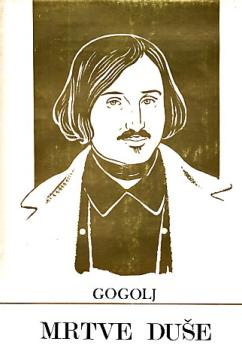
Mrtve duše

Mrtve duše

Nikolaj Vasiljevič Gogolj

Dead Souls (1842) is a brilliant satire that exposes the moral and social rot of imperial Russia through Chichikov's fraud with dead serfs, with Gogol's virtuoso mix of humor, irony and lyricism.

The novel Dead Souls is a satirical masterpiece of Russian literature that criticizes the social and moral deviations of Tsarist Russia. The main character, Chichikov, a charming swindler, travels through the provinces buying up "dead souls" - the names of deceased serfs who are still on the landowners' lists, for which taxes are paid. His plan is to use these souls as collateral to obtain loans and become rich.

The plot follows Chichikov as he negotiates with various landowners, from the stingy Korobochka to the wasteful Nozdryov and the melancholic Plyushkin. Each character reveals different characters and weaknesses of Russian society - greed, vanity, stupidity and moral decline. Gogol masterfully uses humor and irony, creating grotesque portraits that depict corruption and spiritual emptiness. Chichikov's seemingly meaningless enterprise becomes a metaphor for the trade in nothingness in a society devoid of values.

The novel, conceived as a trilogy modeled after Dante's Divine Comedy, remained unfinished. The first part, the only one published, ends with Chichikov's escape after his deception is discovered. Gogol's style combines realism, satire, and lyrical digressions, such as the famous passage about Russia as a troika rushing into the unknown.

Translation
Milovan i Stanka Đ. Glišić
Editor
Izet Sarajlić
Graphics design
Mario Mikulić
Dimensions
21 x 17 cm
Pages
343
Publisher
Veselin Masleša, Sarajevo, 1969.
 
Latin alphabet. Hardcover with dust jacket.
Language: Croatian.

One copy is available

Condition:Used, excellent condition
 

Are you interested in another book? You can search the offer using our search engine or browse books by category.

You may also be interested in these titles

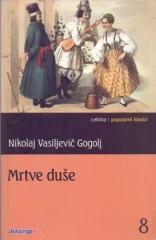
Mrtve duše

Mrtve duše

Nikolaj Vasiljevič Gogolj

Dead Souls (1842) is a brilliant satire that exposes the moral and social rot of imperial Russia through Chichikov's fraud with dead serfs, with Gogol's virtuoso mix of humor, irony and lyricism.

Jutarnji list, 2004.
Croatian. Latin alphabet. Paperback.
4.24 - 4.99
Taras Buljba

Taras Buljba

Nikolaj Vasiljevič Gogolj
Veselin Masleša, 1985.
Croatian. Latin alphabet. Hardcover.
2.99 - 3.12
Taras Buljba

Taras Buljba

Nikolaj Vasiljevič Gogolj
Svjetlost, 1961.
Croatian. Latin alphabet. Paperback.
2.78 - 3.98
Sabrana djela A. P. Čehova #1: Humoreske

Sabrana djela A. P. Čehova #1: Humoreske

Anton Pavlovič Čehov

This book includes Chekhov's works from 1880-1885, i.e. humoresques, short stories, and sketches, starting with Letters to a Learned Neighbor, which Chekhov considered the beginning of his literary career.

Zora, 1959.
Croatian. Latin alphabet. Hardcover with dust jacket.
9.54
Mati

Mati

Maksim Gorki

Maxim Gorky's novel "Mother" was published in 1906 and is one of the key works of Russian social realism. The work depicts the awakening of the working class in Russia through characters and events that emphasize social injustices and the need for revolut

Svjetlost, 1975.
Croatian. Latin alphabet. Hardcover.
4.26
Džingis-kan

Džingis-kan

Vasilij Jan

Vasily Yan's novel Genghis Khan depicts the rise of the Mongol leader Temujin, from childhood in the steppes to the creation of the largest empire in the world, highlighting his courage, cruelty, and relentless will to power.

Rad, 1988.
Serbian. Latin alphabet. Hardcover.
9.78