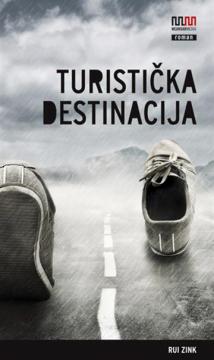
Turistička destinacija

Turistička destinacija

Rui Zink

A tourist destination deals with the question of the destination, the question of where we are going, as well as the idea of ​​tourists. A tourist is someone who doesn't know how things will unfold in the future, who is just visiting, just passing through

Rui Zink is in fashion. That is the inevitable truth. He started with the television show Night of Evil Languages, continued writing chronicles for the daily newspaper Independente... and then an experimental theater group from the University of Aveiro, delighted by Zink's stories Reality now in color, made a theater play based on that book.

In the daily newspaper Visao, March 7, 1996.

Rui Zink is a storyteller who plunges into the chaos and absurdity of everyday life, a sharp satirist, a master of irony - irony that sometimes backfires on the author himself - and a skilled craftsman of the Portuguese language. His works reflect the complexity of literature and life, the meaninglessness of institutions and their hypocrisy, the anxiety of the moment, love and sex, family and memory, the blindness of the media, the carefree ignorance of many people and, not least, the constant presence of death, which usually arrives in a stupid and funny way.

From a review by Helena Vasconcelos, 2005.

In one of these tourist programs - seven days of half-board in a country ravaged by war, where the beaches are mined and full of shells, where kidnappings of tourists are a daily occurrence - the protagonist of these pages, Servajit Duvla, to the readers Greg (tourist pseudonym), or according to the local taxi driver, Gereg, due to difficulties in pronunciation, finds himself. We learn that, due to some mishaps related to his son's moral honor, Greg paid for that tourist destination for one reason only: he wants to die, to kill himself.

Pedro Neves, February 3, 2009.

Original title
O destino turistico
Translation
Tanja Tarbuk
Editor
Branko Čegec
Dimensions
19.5 x 11.5 cm
Pages
207
Publisher
MeandarMedia, Zagreb, 2011.
 
Latin alphabet. Paperback.
Language: Croatian.
ISBN
978-9-53735-589-0

One copy is available

Condition:Used, excellent condition
Specificity of this instance:
Dedication
 

Are you interested in another book? You can search the offer using our search engine or browse books by category.

You may also be interested in these titles

Deobe

Deobe

Dobrica Ćosić

Deobe is a novel about the tragic division of Serbs into Chetniks and Partisans during World War II. Winner of the NIN Award, it is part of a wider epic trilogy, inspired by Ćosić's experiences and historical documents.

Prosveta, 1963.
Croatian. Latin alphabet. Hardcover with dust jacket.
13.74
Pripovetke iz levog i desnog džepa

Pripovetke iz levog i desnog džepa

Karel Čapek

These stories deal with different topics, although most deal with different criminal acts, from fraud and fortune-telling to marriage fraud and murder.

Jugoslavijapublik, 1980.
Croatian. Latin alphabet. Hardcover.
5.22
Usta puna zemlje

Usta puna zemlje

Branimir Šćepanović

The novel "Usta puna zemlje" (1970), the masterpiece of the Serbian writer Branimir Šćepanović, is a psychologically in-depth explorer of the limits of the human soul, solitude and existential freedom, reminiscent of Kafka and Camus.

BIGZ, 1987.
Serbian. Latin alphabet. Paperback.
3.96 - 3.98
Amandino vjenčanje

Amandino vjenčanje

Jenny Colgan

A romantic comedy about friendship, love, and the chaotic attempts to save a good man from a bad marriage. A chick-lit hit, it reminds us that friendship saves more than any plan, and love comes unexpectedly.

Znanje, 2001.
Croatian. Latin alphabet. Paperback.
5.36
Stotina godina (antikronika)

Stotina godina (antikronika)

Dario Harjaček

The novel One Hundred Years by Dario Harjaček provides a panoramic view of Trešnjevka and its inhabitants through a century of changes, ideologies, and human destinies – a mosaic of Zagreb in which life, art, and history intertwine.

Oceanmore, 2025.
Croatian. Latin alphabet. Paperback.
13.42
V.

V.

Thomas Pynchon

The novel represents a journey into an alternative world – a world that we all belong to from time to time, but of which we would not want to be a part, a world of paranoia and alienation that we are not entirely sure is just an alternative or the bare tr

Čarobna knjiga, 2010.
Serbian. Latin alphabet. Paperback.
21.98