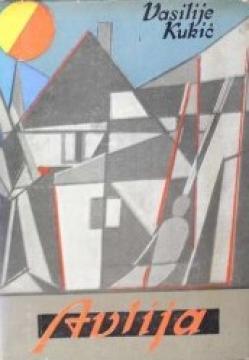
Avlija

Avlija

Vasilije Kukić

The courtyard is a deep analysis of human relations in the Bosnian context, where Kukić explores the universal themes of love, freedom and morality through the prism of the community in the courtyard, with a strong sense of the local color and historical

The novel "Avlija" is set in a small town in Bosnia and Herzegovina during the Ottoman rule, and through the story of a small community in a courtyard, it explores human destinies, moral dilemmas and social relationships. The courtyard, as a central symbol, represents a closed world where different cultures, religions and destinies mix, reflecting the complexity of Bosnian multicultural society.

The plot follows the everyday life of the courtyard's inhabitants: from merchants and craftsmen to ordinary people faced with love, family and existential challenges. Through a series of episodes, Kukić depicts conflicts between tradition and modernity, individual desires and collective norms. The characters are complex – everyone carries their own burdens, from unfulfilled dreams to hidden guilt. The characters of the old imam, whose wisdom and melancholy connect the stories, and the young girl whose love story symbolizes the longing for freedom, stand out in particular.

Kukić's style is realistic, with an emphasis on detailed descriptions of the setting and psychological introspection. The language is rich, imbued with local expressions, which gives authenticity to the presentation of the Bosnian milieu. The novel is read as a mosaic of stories, where the courtyard becomes a metaphor for life - a space of coexistence, but also of conflict.

Editor
Radivoje Pešić
Graphics design
Jovan Kukić
Dimensions
19.5 x 13.5 cm
Pages
214
Publisher
Kosmos, Beograd, 1963.
 
Latin alphabet. Hardcover with dust jacket.
Language: Serbian.

One copy is available

Condition:Used, very good condition
Damages or inconvenience notice:
  • The cover is missing
 

Are you interested in another book? You can search the offer using our search engine or browse books by category.

You may also be interested in these titles

Deobe

Deobe

Dobrica Ćosić

Deobe is a novel about the tragic division of Serbs into Chetniks and Partisans during World War II. Winner of the NIN Award, it is part of a wider epic trilogy, inspired by Ćosić's experiences and historical documents.

Prosveta, 1963.
Croatian. Latin alphabet. Hardcover with dust jacket.
13.74
Aurorin poticaj

Aurorin poticaj

Erich Hackl

The work is based on a true event that occurred in Spain in 1933: Aurora Rodriguez killed her daughter Hildegart, a famous fighter for women's emancipation and a cult figure on the political scene of the time.

Mladost, 1990.
Croatian. Latin alphabet. Hardcover with dust jacket.
4.96 - 4.98
V.

V.

Thomas Pynchon

The novel represents a journey into an alternative world – a world that we all belong to from time to time, but of which we would not want to be a part, a world of paranoia and alienation that we are not entirely sure is just an alternative or the bare tr

Čarobna knjiga, 2010.
Serbian. Latin alphabet. Paperback.
21.9816.49
I ne reče ni reči

I ne reče ni reči

Heinrich Böll

In Boll's novels, one of the central themes is the attempt to preserve basic moral values ​​in a time of terror, as well as in a period of material prosperity and corruption.

Svjetlost, 1965.
Serbian. Latin alphabet. Paperback.
3.22 - 3.98
Proces

Proces

Franz Kafka

Kafka wrote The Process between 1914 and 1915, published posthumously in 1925. The novel is unfinished but with an added final chapter by Max Brod. Edition with a foreword by B. Živojinović and an afterword by Walter Killi.

BIGZ, 1990.
Serbian. Latin alphabet. Paperback.
4.26
Crna kutija

Crna kutija

Amos Oz

The Black Box is a kaleidoscope of married life and love relationships. It is a novel that implicitly speaks about all of us.

Hena Com, 2001.
Croatian. Latin alphabet. Hardcover.
10.98