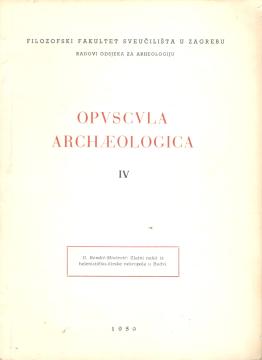
Opuscula archaeologica IV: Zlatni nakit iz helenističko-ilirske nekropole u Budvi

Opuscula archaeologica IV: Zlatni nakit iz helenističko-ilirske nekropole u Budvi

Duje Rendić-Miočević

The article presents a classic analysis of archaeological findings from the Hellenistic period (3rd-2nd century BC) in the necropolis north of ancient Budva (today's Montenegro), discovered in the 1950s.

The author catalogues and describes in detail the gold jewellery from 12 graves: spiral bracelets in the shape of snakes made of thin gold sheet (wt. 10-20 g), earrings with pyramidal designs (upturned pyramids with granulated decorations), circular zoomorphic earrings with lion and bull motifs, fibulae, rings with intaglio and chains with pendants. He analyses the processing techniques (forging, filigree work, granulation), styles (Hellenistic influences with Illyrian variants) and context: the jewellery was found in female and male graves with ceramics, bronze and iron, indicating elite burial rituals. Rendić-Miočević compares it with parallel finds from Glasinac, Trebenište and Greek centres, dating them to the Macedonian phase of Hellenism.

These objects, weighing a total of over 200 g, are rare examples of high-value gold in the Illyrian region, testifying to the wealth of local tribes (probably the Doclea or Labeati). The motifs (snakes as a symbol of protection, zoomorphic elements) reveal a synthesis of Greek influences and autochthonous symbolism, and the quality of the workmanship points to masters from Macedonia or Epirus. The findings confirm Budva as an important commercial and cultural center on the Adriatic.

The work enriches the picture of Illyrian civilization, illustrating Hellenistic acculturation in the Balkans: the spread of Greek art through trade and migration, social hierarchy (jewelry as a status symbol), and ethnic interactions. As one of the first detailed studies of Illyrian gold, it influenced later research (e.g. in Trebenište, Apollonia), helping to reconstruct Balkan routes and the transition from the Iron Age to the Hellenistic Age. It remains a reference for understanding the pre-Roman Adriatic and Illyrian-Greek connections.

Dimensions
23 x 17 cm
Pages
60
Publisher
Filozofski fakultet Sveučilišta u Zagrebu, Zagreb, 1959.
 
Latin alphabet. Paperback.
Language: Croatian.

One copy is available

Condition:Used, excellent condition
Discounted price: 9.366.55
30% discount is valid until 3/23/26 11:59 pm
 

Are you interested in another book? You can search the offer using our search engine or browse books by category.

You may also be interested in these titles

Kraj vremena: Revizija proročanstva Maya

Kraj vremena: Revizija proročanstva Maya

Adrian Gilbert

British author Adrian Gilbert (co-author of The Mayan Prophecies from 1995) in The End of Time offers the most thorough and sober modern interpretation of the Mayan calendar and the so-called "2012 prophecy", completely rejecting New Age hysteria.

Stari grad, 2009.
Croatian. Latin alphabet. Hardcover.
18.22 - 18.26
Otisci bogova: Potraga za početkom i krajem

Otisci bogova: Potraga za početkom i krajem

Graham Hancock

Hancock's evidence reveals not only the clear footprints of an unknown civilization that flourished during the last ice age, but also the terrifying truth about the scale of the catastrophe that wiped out almost all traces of it.

Stari grad, 2002.
Croatian. Latin alphabet. Hardcover.
19.22 - 19.36
Armagedonske bitke: Megido i Jizreelska dolina od Brončanoga do Nuklearnoga doba

Armagedonske bitke: Megido i Jizreelska dolina od Brončanoga do Nuklearnoga doba

Eric H. Cline

The book by a world-renowned archaeologist and historian explores Megiddo (Hebrew: Har Megiddo, Greek: Armageddon) and the Jezreel Valley as the bloodiest battlefield in world history. Over 4,000 years, 34 major battles were fought in this strategic pass.

Stari grad, 2005.
Croatian. Latin alphabet. Hardcover.
13.22 - 13.36
Arktička pradomovina Veda

Arktička pradomovina Veda

Bal Gandahar Tilak

The book The Arctic Homeland of the Vedas (1903) by the Indian scholar Tilak proposed the hypothesis that the ancient Aryans, the authors of the Rigveda, originated in the Arctic region. Although controversial, the book remains important in the study of V

NIRO Književne novine, 1987.
Serbian. Latin alphabet. Paperback.
17.56
Talisman: sveti gradovi, tajna vjera

Talisman: sveti gradovi, tajna vjera

Graham Hancock, Robert Bauval

Talisman is an exciting intellectual journey through the hidden streets and underground canals of history in search of traces of the secret religion that shaped the world, hidden in architecture and monuments.

Stari grad, 2006.
Croatian. Latin alphabet. Hardcover.
24.42 - 24.46
Prije potopa: Dokaz da je biblijski potop bio stvaran događaj

Prije potopa: Dokaz da je biblijski potop bio stvaran događaj

Ian Wilson

British historian Ian Wilson (known for his books on the Shroud of Turin and Jesus) offers the most thorough defense of the thesis that the biblical flood was a real historical event, not just a myth, in his work Before the Flood.

Stari grad, 2007.
Croatian. Latin alphabet. Hardcover.
16.22 - 16.28