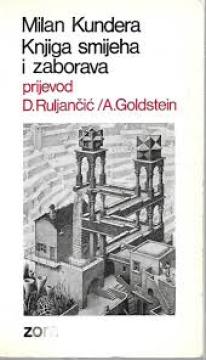
Knjiga smijeha i zaborava

Knjiga smijeha i zaborava

Milan Kundera

The novel The Book of Laughter and Forgetfulness (1979), a fragmentary novel in seven parts, explores Czech history under the communist regime, particularly after the 1968 Prague Spring and the Soviet invasion.

Kundera, an exile in Paris, combines satire, erotic motifs, and philosophical digressions, mocking totalitarianism through stories of the manipulation of memory and identity.

Through characters such as Ludvik, an engineer rehabilitated after a false accusation, and Tamara, who flees into exile, the novel depicts how the regime erases the past – from destroyed monuments to betrayals by friends – while laughter becomes a weapon: angelic (liberating, individual) versus diabolical (collective, destructive). Erotic scenes, such as those between lovers in Paris or during the invasion, emphasize the lightness and heaviness of existence, the conflicts of mind and body, public and private.

Kundera warns that forgetting is not a passive loss, but an active erasure: just as the image of Clementis is erased from history from a photograph next to Gottwald, so personal memories are extinguished. The novel, written in Czech and translated into English, criticizes false narratives and celebrates art as resistance. Relevant in an age of manipulation, Kundera sees it as a "novel of ideas" where history becomes a metaphor for loneliness and hope in laughter.

Original title
Kniha smíchu a zapomnění
Translation
Albert Goldštajn, Dagmar Ruljančić
Editor
Vjeran Zuppa
Graphics design
Sanja Iveković
Dimensions
19 x 12 cm
Pages
262
Publisher
Grafički zavod Hrvatske (GZH), Zagreb, 1982.
 
Latin alphabet. Paperback.
Language: Croatian.

One copy is available

Condition:Used, excellent condition
Damages or inconvenience notice:
  • A message of a personal nature
Discounted price: 9.367.02
25% discount is valid until 3/23/26 11:59 pm
 

Are you interested in another book? You can search the offer using our search engine or browse books by category.

You may also be interested in these titles

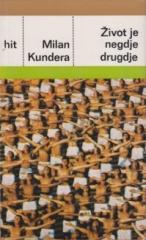
Život je negdje drugdje

Život je negdje drugdje

Milan Kundera

Jaromil, a young poet raised by a possessive mother, seeks a "real life" in poetry and revolution. His lyrical youth, love, and idealism lead him into conformity and betrayal of intimate relationships – he dies young and unfulfilled.

Znanje, 1979.
Croatian. Latin alphabet. Hardcover with dust jacket.
4.86
Štefica Cvek u raljama života

Štefica Cvek u raljama života

Dubravka Ugrešić

Do you like "lovelies"? Whatever you think about them, you'll enjoy this superb pastiche of trivial romance novels.

Mladinska knjiga, 1990.
Croatian. Latin alphabet. Hardcover with dust jacket.
4.94
Pustolovine Toma Sawyera

Pustolovine Toma Sawyera

Mark Twain

The Adventures of Tom Sawyer is the first truly realistic children's novel, not only in American but also in world children's literature. Twain's most famous work and a favorite children's book in which the writer described his boyhood experiences.

Nakladni zavod Hrvatske, 1947.
Croatian. Latin alphabet. Hardcover.
16.32
Rudnik čvaraka

Rudnik čvaraka

Tomislav Šovagović

The debut work of Croatian writer Tomislav Šovagović, awarded the Josip and Ivan Kozarac Award in 2012, is a dedication to Slavonia – the region of his childhood that the author, born in Dalmatia, observes with foreign but tender eyes.

Mozaik knjiga, 20112.
Croatian. Latin alphabet. Paperback.
11.56
Deobe 1-3

Deobe 1-3

Dobrica Ćosić

This work, awarded the NIN Prize for that year, is considered one of the most significant in Serbian literature after World War II.

Prosveta, 1961.
Serbian. Cyrillic alphabet. Hardcover with dust jacket.
The book consists of 3 volumes
11.42
Ljubičice u srijedu

Ljubičice u srijedu

Andre Maurois

André Maurois, a French writer known for his psychological novels and biographies, explores themes of family relationships, love, and internal conflicts in this work, which is characteristic of his style.

Svjetlost, 1965.
Croatian. Latin alphabet. Paperback.
3.42 - 3.62