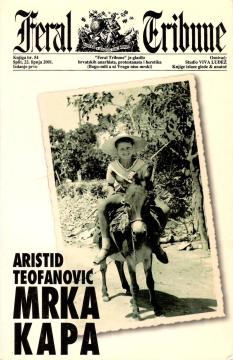
Mrka kapa
Rare book

Mrka kapa

Aristid Teofanović

Mrka kapa is a book of short prose written under the pseudonym Aristid Teofanović, used by Slobodan Blagojević. Blagojević is also known by the heteronym Anhel Antonić (poetry) and other works under his real name.

The book is divided into three thematic units:

  • Grammatical errors – linguistic, stylistic and logical "errors" as a satire on social and political rhetoric, bureaucracy, media and everyday absurdity.
  • Incomplete table of instinctual elements – more introspective, psychological texts about instincts, desire, frustration, eros and thanatos; a mixture of erotic, existential and cynical.
  • Traffic jam – urban chaos, war and post-war context (1990s, break-up of Yugoslavia), migrations, identity crises; fragments of life in the "traffic jam" of history and exile.

The style is ironic, sarcastic, fragmentary, often darkly humorous and provocative. The texts are short, sharp, with elements of absurdity, parody and self-irony – typical Feral spirit (satire, criticism of nationalism, war madness, transitional chaos). It does not have a linear plot; is more of a collection of "notes", aphorisms in prose, vignettes and mini-essays.

Blagojević addresses the themes of the senselessness of war, exile, linguistic manipulation, sexuality as an escape, criticism of social norms and "mrka kapa" - metaphors for a dark, sad or absurd fate (the term "mrka kapa" in the vernacular means something bad, ruin or no way out).

The book is part of Blagojević's opus from the 1990s/2000s, similar to Letters to the Capital Newspaper (1992/2001) - satirical, anti-war, intellectually sharp prose. Today rare in second-hand stores, appreciated among fans of Feral and post-Yugoslav satirical literature.

Dimensions
21 x 13 cm
Pages
257
Publisher
Feral Tribune, Split, 2001.
 
Latin alphabet. Paperback.
Language: Croatian.

One copy is available

Condition:Used, excellent condition
 

Are you interested in another book? You can search the offer using our search engine or browse books by category.

You may also be interested in these titles

Why We Suck: A Feel Good Guide to Staying Fat, Loud, Lazy and Stupid

Why We Suck: A Feel Good Guide to Staying Fat, Loud, Lazy and Stupid

Denis Leary

A satirical, uncompromising and highly provocative book by Denis Leary, comedian and stand-up artist, written in the form of a long, cynical, swearing and aggressive monologue that reads like an extended stand-up performance on paper.

Penguin books, 2009.
English. Latin alphabet. Paperback.
6.36
Zrnca pijeska na obalama vječnosti

Zrnca pijeska na obalama vječnosti

Natalija Vorobjeva-Hržić

Grains of sand on the shores of eternity is a collection of autobiographical stories by the Russian-Croatian writer Natalija Vorobjova Hržić.

Mozaik knjiga, 2016.
Croatian. Latin alphabet. Paperback.
6.48 - 7.32
Po-etika, knjiga druga

Po-etika, knjiga druga

Danilo Kiš

A collection of interviews that complements the first book of essays from 1972. As a lecturer in Serbo-Croatian at the University of Bordeaux, Kiš reveals in conversations the core of his "po-ethics" - a morally and aesthetically charged vision of literat

Ideje, 1974.
Serbian. Latin alphabet. Paperback.
8.56
Primicanje katastrofa: Propasti koje prijete našem svijetu

Primicanje katastrofa: Propasti koje prijete našem svijetu

Isaac Asimov

A popular science work in which Asimov, combining scientific rigor with a lucid style, explores possible threats to the survival of humanity, systematizing disasters according to their nature and probability.

August Cesarec, 1981.
Croatian. Latin alphabet. Hardcover with dust jacket.
7.465.60
Dnevnici, 1. svezak: 1909-1912.

Dnevnici, 1. svezak: 1909-1912.

Franz Kafka

Kafka's diaries, published posthumously, reveal the inner world of an anxious genius. The first volume covers his early years, when Kafka worked as an insurance clerk in Prague, faced with a dreary life and literary ambitions.

Tim press, 2022.
Croatian. Latin alphabet. Paperback.
15.42
Kako što nastaje: novine, film, teatar

Kako što nastaje: novine, film, teatar

Karel Čapek

In a witty and instructive essay, Čapek describes how a newspaper, a film, and a theater play are created. Through humor and irony, he shows the complexity of the process – from idea to realization – and the different perspectives of the participants, dem

Znanje, 1985.
Croatian. Latin alphabet. Paperback.
4.76