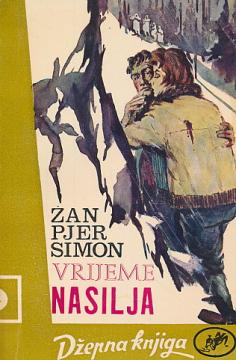
Vrijeme nasilja

Vrijeme nasilja

Jean-Pierre Simon

A Time of Violence (1966) is an anti-war and activist novel by French writer Jean-Pierre Simon, a lesser-known author from the mid-20th century, whose work bears traces of leftist literature of the 1930s and 1940s.

The story follows the life of the main character Jean, a Frenchman who joins the International Brigades in the Spanish Civil War in 1936. The novel is divided into two main periods: the first is his participation in the battles on the Republican side against the fascists, where he witnesses the brutality of the war, ideological conflicts, heroism and betrayals. The second part describes his life in captivity and a concentration camp after the Republican defeat, where he suffers hunger, torture, humiliation and the struggle for survival.

Simon realistically and without pathos depicts violence as an everyday reality of war and repression: physical violence, psychological crushing, loss of illusions and dehumanization. The novel is not only a war chronicle, but also a criticism of fascism, totalitarianism and the senseless violence, with an emphasis on solidarity among prisoners and a desperate struggle to preserve humanity.

The style is direct, documentary, with elements of autobiography or reportage (similar to Malraux or Hemingway in the Spanish theme). The work was popular in Yugoslavia in the 1960s, attracting readers interested in anti-fascist and anti-war prose. Today it is considered a rare example of French literature on the Spanish Civil War translated into our country, appreciated for its authentic portrayal of historical events and its universal message about the price of violence.

Original title
Terre de violence“
Translation
Srećko Džamonja
Editor
Risto Trifković
Graphics design
Mirko Stojnić
Dimensions
16.5 x 11 cm
Pages
195
Publisher
Svjetlost, Sarajevo, 1965.
 
Latin alphabet. Paperback.
Language: Croatian.

One copy is available

Condition:Unused
 

Are you interested in another book? You can search the offer using our search engine or browse books by category.

You may also be interested in these titles

Glavom o zid

Glavom o zid

Zvonimir Mikulić-Đono

Zvonimir Mikulić's novel is dedicated to the young people who distinguished good from evil in the chaos of the Homeland War, often sacrificing their lives. The work seeks to preserve from oblivion their great sacrifice and the small world that was im

HKD Napredak, 2015.
Croatian. Latin alphabet. Paperback.
8.56
Baraka Pet Be i druge novele

Baraka Pet Be i druge novele

Miroslav Krleža

The collection "Baraka Pet Be i druge novele" brings a selection of Krleža's anti-war novels from the period 1916–1920s, focusing on the senselessness of World War I, the suffering of the Home Guard and the downfall of Austria-Hungary.

Mladost, 1987.
Croatian. Latin alphabet. Hardcover.
5.38
Matijino stoljeće rata

Matijino stoljeće rata

Ivan Šimić

Matija's Century of War is an epic, so Croatian story about the 20th century written in a superior narrative and style, which you will not read, but swallow!

Despot Infinitus d.o.o., 2024.
Croatian. Latin alphabet. Paperback.
9.76
Izvještaji s bojišta

Izvještaji s bojišta

Michael Herr

A book written by American journalist Michael Herr and considered one of the most influential works on the Vietnam War. First published in 1977, it is based on Herr's experiences as a war correspondent during the Vietnam War.

Mladost, 1979.
Croatian. Latin alphabet. Hardcover with dust jacket.
6.32
Istok i Zapad

Istok i Zapad

Gerald Green

In East and West (1986), Green weaves an epic tale of love and war, intertwining the lives of ordinary people with great historical events. The novel is a powerful fresco of war, but also of an indestructible spirit seeking light amidst darkness.

August Cesarec, 1990.
Croatian. Latin alphabet. Paperback.
The book consists of two volumes
7.42
Čočara

Čočara

Alberto Moravia

Widow Cesira and her daughter Rosetta flee bombed Rome to their native Ciociaria, where they experience hunger, fear and misery. Liberation brings tragedy: Rosetta is raped by Moroccan soldiers, destroying their faith in God and people.

Otokar Keršovani, 1966.
Croatian. Latin alphabet. Hardcover.
3.96