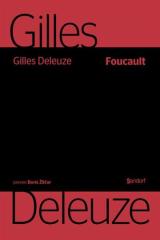
Foucault
Deleuze's Portrait of Foucault (1986) is not a monograph, but a creative "thinking with Foucault." It analyzes the archaeology of knowledge, introducing the concepts of archive, power, subjectification, and "fold" as crucial to Foucault's thought on knowl
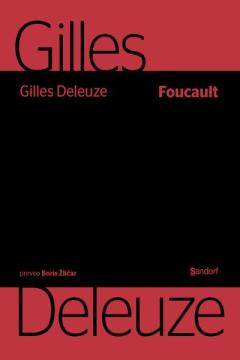
Foucault (1986) was written by Gilles Deleuze two years after Foucault's death (1984) as an intimate intellectual hommage and "mental portrait" of a friend. It is not a simple introduction or summary of Foucault's works, but a deeply creative reading – Deleuze "thinks with Foucault", develops his concepts further, using his own philosophical apparatus (rhizome, event, forces...).
The book is divided into two main parts:
- From the archive to the diagram
- The New Archivist (Archaeology of Knowledge, 1969): Foucault's knowledge is not a continuous history of ideas, but discursive formations – the "visible" and the "sayable" (visible and articulated). Deleuze introduces the notion of the archive as a system that determines what can be said and seen in an epoch.
- The New Cartographer (To Discipline and Punish, 1975): Foucault moves from discourse to practices of power – from sovereign power to discipline (panopticon, prison, school, factory). Deleuze interprets it as a diagram – an abstract machine of power that distributes forces.
- Topology: "Think differently"
- Strata (knowledge): historical formations of the visible and the sayable.
- Strategies (power): thought outside (thought of the outside) – power is not repressive, but productive, power relations.
- Folds / folds (subjectivation): late Foucault (self-care, ethics) – the subject is not given, but is created by "folding" external forces inwards. This is Deleuze's key innovation: Foucault's subject as "the inside of the outside", resistance to power through the aesthetics of existence.
Deleuze sees Foucault's thought as a continuous evolution: from archeology → genealogy of power → ethics of the subject. He especially emphasizes the "death of man" not as nihilism, but as the liberation of life, work and language from an anthropocentric figure. The appendix on "the death of man and the superman" connects Foucault with Nietzsche.
The style is dense, poetic, full of Deleuze metaphors (diagram, fold, forces), which makes it a challenging but also exciting read. Many consider it one of the best interpretations of Foucault – not objective, but productive, because Deleuze creates a "Foucault-Deleuze".
One copy is available