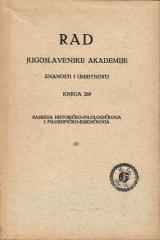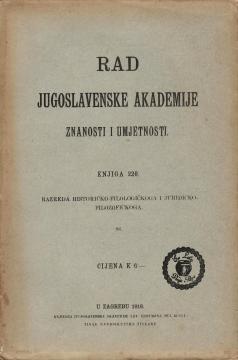
Rad JAZU: Knjiga 220 razreda historičko-filologičkoga i filozofičko-juridičkoga
This issue of the JAZU proceedings brings together works on literary analysis, Slavic liturgy, ontological-noetic issues, and the translation of Pilpaj's fables and Kašić's work.
The book 220 Works of the Yugoslav Academy of Sciences and Arts, Department of History‑Philology and Law‑Philosophy, brings together works that connect literature, linguistics, philosophy and the history of spirituality. The structure of the collection reflects a wide range of research interests within the humanities.
The first contribution was written by Vladoje Dukat, and deals with Lovrenčević's work "Petrica Kerempuh". The author analyzes the stylistic peculiarities, linguistic wit and cultural context of this important work of Croatian literature, emphasizing its connection with folk tradition and satirical expression.
The following is the work of Ante Liepopili, who studies Slavic liturgy in Dubrovnik. The focus is on liturgical texts, historical circumstances of their use and cultural interactions between Slavic and Latin church traditions. The influence of Slavic rites on Dubrovnik's spiritual and literary culture is emphasized.
The third contribution is signed by dr. Stjepan Zimmermann, dedicated to the ontological-noetic problem in the evolution of philosophy. The author considers the development of fundamental philosophical questions about being and cognition, connecting them with changes in European intellectual history. Key breaks and changes in the understanding of fundamental metaphysical concepts are highlighted.
In the following paper, T. Matić* analyzes Relković's translation of Pilpaj's fables. Through a comparison of the original and the translation, the importance of Relković's language, the choice of stylistic solutions, and the meaning of fables in the tradition of moral-didactic literature are presented.
The collection ends with an article by dr. Marijan Stojković, who deals with the work of D. I. Kašić, exploring his philological and cultural efforts. The paper emphasizes Kašić's contribution to the standardization of the language and the formation of Croatian early modern literature.
One copy is available