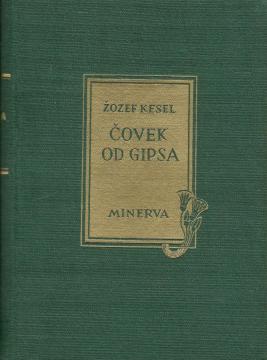
Putevi nesreće IV: Čovek od gipsa

Putevi nesreće IV: Čovek od gipsa

Joseph Kessel

The final part of the Paths of Misfortune tetralogy. Richard Dalleau, broken by losses, drugs and internal conflicts, faces the consequences of his turbulent life and seeks salvation in despair and remorse.

The Plaster Man is the final, fourth part of Joseph Kessel's great tetralogy *The Tour of Misfortune (Le Tour du malheur). Published in 1950, this novel represents a poignant conclusion to the epic story of Richard Dalleau and his generation.

After the turbulent years of war, the rise of his legal career, passionate loves, political intrigues and moral decline, Richard finds himself on the brink of the abyss. Broken by the suicide of loved ones, drug addiction, disappointments and internal conflicts, he becomes a “plaster man” – fragile, vulnerable and seemingly immobile in his mental paralysis. The novel follows his desperate struggle to return to himself, to find meaning and to atone for the sins of his youth.

With great emotional power and autobiographical overtones, Kessel describes the dark side of ambition, hedonism and post-war Paris. Drugs, jealousy, the collapse of marriages and the search for meaning in a world that has lost its values ​​form the core of this powerful finale. The style is intense, masculine and melancholic – typical of Kessel at his best.

The Plaster Man is not just the story of one man, but of an entire generation that went through the Great War only to be lost in peace. The tetralogy ends on a deep, almost requiem note, where the idealism of youth collides with the bitter reality of life.

Original title
L'Homme de plâtre
Translation
Andra Milosavljević
Editor
Tanasije Mladenović
Illustrations
Olivera Mitrašinović
Graphics design
Stevan Vujkov
Dimensions
20 x 14 cm
Pages
362
Publisher
Minerva, Subotica, 1959.
 
Latin alphabet. Hardcover.
Language: Serbian.

One copy is available

Condition:Unused
 

Are you interested in another book? You can search the offer using our search engine or browse books by category.

You may also be interested in these titles

Ljepotica dana

Ljepotica dana

Joseph Kessel

The novel The Beauty of the Day by French author Joseph Kessel, published in 1928, explores the complex psychological and emotional layers of the main character, Séverine Sérizy.

Nakladni zavod Matice hrvatske, 1973.
Croatian. Latin alphabet. Hardcover.
8.46
Lav

Lav

Joseph Kessel
Nolit.
Serbian. Latin alphabet. Paperback.
4.88
Sužnji

Sužnji

Joseph Kessel

The Book of Illness, Fear and Comfort

Narodne novine, 1927.
Croatian. Latin alphabet. Hardcover.
9.98
Očajnički prkos

Očajnički prkos

Barbara Cartland

Desperate Defiance (1936) is a romance novel in which Cartland masterfully combines romance with adventure, criticizing the social norms of the 1930s: the pressure on women to choose between tradition and freedom.

Sara 93, 1997.
Croatian. Latin alphabet. Hardcover.
6.42
Obećaješ li da nećeš nikome reći?

Obećaješ li da nećeš nikome reći?

Mary Jane Clark

The novel Will You Promise Not to Tell? (2000), the second part of the series about KEY News journalists, is a tense crime thriller set in the world of high-stakes auctions and hidden secrets of New York.

Naklada AS, 2004.
Croatian. Latin alphabet. Hardcover.
3.48
Kod bijelog konja

Kod bijelog konja

Agatha Christie

In the novel At the White Horse (1961), Christie combines the supernatural and the rational in a story of mysterious deaths and an organization that offers "services" of elimination, inspired by Dennis Wheatley, with a focus on inheritance and the ethics

Globus, 1984.
Croatian. Latin alphabet. Hardcover with dust jacket.
8.34