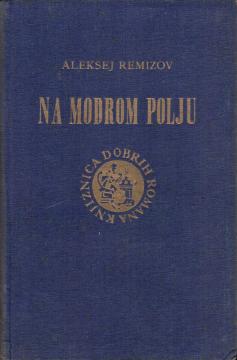
Na modrom polju
Antique
Rare book

Na modrom polju

Aleksej Remizov

The story of a girl named Olya Ilymeneva in a pre-revolutionary Russian village and province. Through a folkloric, ornamental style, Remizov describes her life, family, pilgrims, everyday life, and spiritual quest on the "blue field" of the Russian land.

“On the Blue Field” (1922) is a short novel (story) by Alexei Remizov, one of the most important Russian modernists and émigrés. The novel is autobiographical in tone – it is based on the life of Remizov’s wife Serafima Pavlovna Remizova-Dovgello.

The main character is Olya Ilmenyeva, a girl from a wealthy provincial family in the village of Vatagin, through which the pilgrimage routes to Kiev and Chernigov pass. The story follows her childhood, youth, family relationships, encounters with pilgrims, peasants and everyday life in Russian provincial life in the late 19th and early 20th centuries.

Remizov writes in a characteristic ornamental, folkloric-poetic style – rich in archaisms, repetitions, rhythm and close to Russian oral storytelling and old chronicles. There is no classic dramatic plot or major external conflicts; the action flows calmly, almost chronicling-like, with an emphasis on atmosphere, customs, beliefs and the inner spiritual world of the characters. “Blue Field” symbolizes the Russian land, infinity, sky and the spiritual dimension of life.

The book exudes warmth, melancholy and love for old Russia, its ordinary people, faith and folklore. Remizov masterfully depicts a world full of miracles, suffering and everyday beauty – pilgrims, icons, family stories, nature. The style is demanding, but hypnotic: a mixture of realism, symbolism and Russian ornamentality (tale). The work belongs to his “quieter”, more intimate works, in contrast to the grotesque and demonic stories from the same period.

Original title
В поле блакитном
Translation
Ljubomir Maraković
Editor
Josip Andrić
Dimensions
19 x 13 cm
Pages
172
Publisher
Hrvatsko književno društvo Sv. Jeronima, Zagreb, 1928.
 
Latin alphabet. Hardcover.
Language: Croatian.

One copy is available

Condition:Used, excellent condition
 

Are you interested in another book? You can search the offer using our search engine or browse books by category.

You may also be interested in these titles

U zemlji Amanullaha

U zemlji Amanullaha

Larissa Reissner

A vivid account of the author's trip to Afghanistan in 1921-1922, a country in a turbulent period of modernization under the reformist king Amanullah Khan, the clash of tradition and the new age, and the exotic life of Afghan society.

Naklada Binoza, 1935.
Croatian. Latin alphabet. Hardcover with dust jacket.
7.54
Zlatno tele

Zlatno tele

Ilja Iljf, Evgenij Petrov

The Golden Calf (1931) is a brilliant satirical picaresque adventure, a sequel to the legendary 12 Chairs, where the great schemer Ostap Bender returns in full glory – charming, cynical, irredeemably cunning and always one step ahead of everyone else.

Grafički zavod - Titograd, 1964.
Croatian. Latin alphabet. Hardcover.
5.503.85
Ana Karenjina

Ana Karenjina

Lav Nikolajevič Tolstoj

"Anna Karenina" (1875–1877) is Leo Tolstoy's largest and most complex novel, often considered one of the greatest novels in world literature, praised for the depth of its characters and philosophical questions.

Mladost, 1952.
Croatian. Latin alphabet. Paperback.
The book consists of two volumes
10.36
Prizemna Amerika

Prizemna Amerika

Ilja Iljf, Jevgenij Petrov

At the end of 1935, the famous Russian writing duo set off on a car trip across the United States, where they spent a total of three and a half months.

Grafički zavod Hrvatske (GZH), 1964.
Croatian. Latin alphabet. Hardcover.
9.19 - 9.97
Moskva – Petuški

Moskva – Petuški

Venjedikt Jerofejev

Venedikt Yerofeyev's postmodern prose poem is today considered a classic of new Russian literature. It is compared to Gogol and Kharms for its poetics of absurdity, satire, and metaphysical depth.

LOM, 217.
Serbian. Cyrillic alphabet. Paperback.
11.24
Djetinjstvo

Djetinjstvo

Lav Nikolajevič Tolstoj

Childhood (1852) is the first book of an autobiographical trilogy (with Adolescence and Youth), where Tolstoy explores the world of childhood through the eyes of a ten-year-old boy, Nikolinka Irtenjev – innocence, joys, sorrows and first traumas.

Svjetlost, 1971.
Croatian. Latin alphabet. Hardcover.
6.54