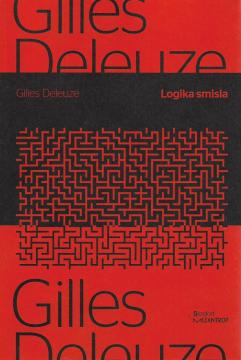
Logika smisla
Gilles Deleuze's The Logic of Sense (1969) is one of his most important philosophical works. It explores the nature of sense, events, surfaces, and nonsense through the paradoxes of language, Stoic philosophy, and literature (Lewis Carroll).
The Logic of Sense (1969) is one of Deleuze's most complex and influential works from his early period. The book consists of 34 series (chapters) that explore in a paradoxical and lucid-poetic way what sense is and how it comes into being.
Deleuze distinguishes three levels: depth (bodies and mixing), surface (events), and height (representation). Sense is neither in the depth of things nor in the height of ideas, but occurs on the surface – as an event (événement), a purely disembodied, ideal entity that does not coincide with either the physical state of things or the propositions of language.
The work abounds in analyses of the Stoics, Lewis Carroll (Alice in Wonderland), Melanie Klein, Nietzsche, and others. Deleuze develops an original philosophy of events, paradoxes, nonsense, and series, and introduces important distinctions between sense and signifier, signified and signification. The final section on the “dynamic genesis” of meaning and the role of the “body without organs” is particularly powerful.
The Logic of Meaning represents a transition between Deleuze’s earlier monographs and his later collaborations with Guattari. The style is brilliant, dense, and full of unexpected connections – typically Deleuzean.
It has been translated into Croatian in an excellent translation by Marko Gregorić and is considered one of the best translations of Deleuze into Croatian. The book is demanding, but extremely stimulating for anyone interested in the philosophy of language, poststructuralism, event theory, and contemporary French thought.
One copy is available