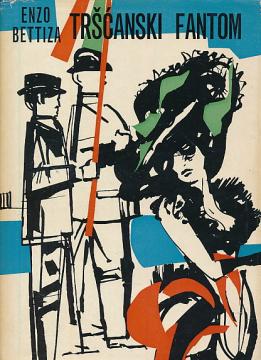
Tršćanski fantom

Tršćanski fantom

Enzo Bettiza

The novel follows Danijelo Solospino's growing up in Trieste before World War I. As he searches for his own identity, he confronts family relationships, love, and the clash of Italian and Slavic cultures.

The Phantom of Trieste by Enzo Bettiza is a psychological and socio-historical novel set in Trieste in the years before World War I. The main character Danijel Solospin is the last descendant of a distinguished Trieste family. He is withdrawn, sensitive and prone to reflection, and through his upbringing the author depicts the conflict between the world of childhood and the complex reality of adults.

Danijel loses his mother at an early age, while his father is carefree and more preoccupied with his own life than with raising his son. He is strongly influenced by his grandfather, a religious nanny from Drniš, and his family friend and physician Dr. Janovich, a broad-minded Slovene who introduces him to humanistic and democratic ideas. Important characters include Uncle Ugo, the painter Pfeffer, the Solospin brothers, and the Cossovel family, through whom Danijel learns about different views on life, art, and politics.

As he grows up, Danijel increasingly sees tensions between Italians and Slavs in Trieste. Although he feels Italian, he discovers that his family has Slavic roots, which causes him deep doubts about his own identity. At the same time, he goes through first loves, friendships and disappointments, and matures by facing social injustices and political conflicts.

Bettiza combines a psychological coming-of-age novel with a depiction of a city at the crossroads of cultures. Trieste is not only a place of action but also a symbol of encounters, conflicts and the intertwining of peoples. The novel conveys that personal identity cannot be built on national prejudices, but on understanding one's own roots and respecting diversity.

Original title
Il fantasma di trieste
Translation
Ante Rojnić
Editor
Danica Visković
Graphics design
Zlatko Prica
Dimensions
20 x 15 cm
Pages
412
Publisher
Naprijed, Zagreb, 1965.
 
Latin alphabet. Hardcover with dust jacket.
Language: Croatian.

One copy is available

Condition:Unused
 

Are you interested in another book? You can search the offer using our search engine or browse books by category.

You may also be interested in these titles

U sjeni bregova

U sjeni bregova

Paola Drigo

The novel depicts the tragic fate of Mariuta (Marije Zef) and her younger sister Rosuta. The work shocked contemporaries with its boldness in depicting taboo subjects, and is today considered a classic portrait of female suffering in rural Italy.

Matica hrvatska, 1961.
Croatian. Latin alphabet. Hardcover with dust jacket.
5.32
Uspomene jednog brijača

Uspomene jednog brijača

Giovanni Germanetto

The autobiography of the Italian communist Giovanni Germanetto (1885–1959). The book vividly and humorously depicts the life of an Italian working-barber from his poor childhood to his involvement in the revolutionary labor movement.

Zora, 1950.
Croatian. Latin alphabet. Hardcover with dust jacket.
7.00
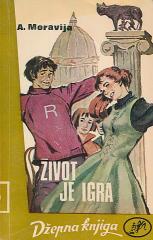
Život je igra

Život je igra

Alberto Moravia

The book consists of several stories that explore the complexity of human behavior, often through an ironic and satirical depiction of everyday life.

Svjetlost, 1965.
Serbian. Latin alphabet. Paperback.
3.46 - 3.72
Pustolovine u samostanu: priče iz Dekamerona

Pustolovine u samostanu: priče iz Dekamerona

Giovanni Boccaccio

In this humorous and satirical story, Boccaccio depicts life in a monastery and ridicules the hypocrisy and weaknesses of people who should live morally and piously.

Naprijed, 1964.
Croatian. Latin alphabet. Paperback.
3.00
Čočara

Čočara

Alberto Moravia

Widow Cesira and her daughter Rosetta flee bombed Rome to their native Ciociaria, where they experience hunger, fear and misery. Liberation brings tragedy: Rosetta is raped by Moroccan soldiers, destroying their faith in God and people.

Otokar Keršovani, 1966.
Croatian. Latin alphabet. Hardcover.
3.96
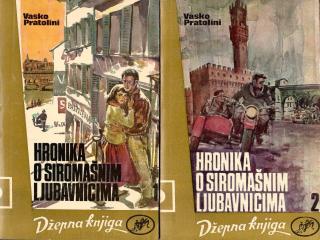
Kronika o siromašnim ljubavnicima

Kronika o siromašnim ljubavnicima

Vasco Pratolini

In Florence 1925–1926, in the poor Via del Corno, the residents live in love, poverty and fear. The arrival of fascism destroys the community: lovers fight, some die from violence, but popular solidarity survives.

Sveučilišna naklada Liber (SNL), 1982.
Croatian. Latin alphabet. Hardcover with dust jacket.
3.76