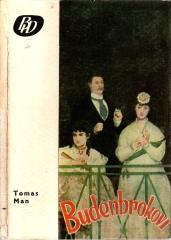
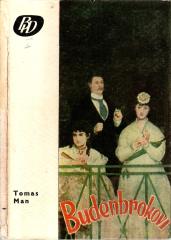
Budenbrokovi
Rijetka knjiga

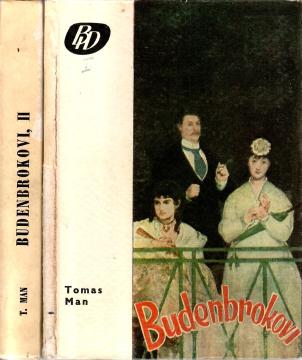
Budenbrokovi

Thomas Mann

The Buddenbrooks is not just a family chronicle – it is a profound, melancholic fresco of how time and change inexorably creep into the core of a respectable bourgeois family, bringing with them a downfall that is both tragic and inevitable.

Mann wrote the novel when he was just 26, drawing on his own family history from Lübeck – a city that is never explicitly mentioned in the book, but pulsates in every scene, in every description of a house, a dinner party, a business conversation. The story follows four generations of the Buddenbrook family, wealthy grain and commodity merchants in northern Germany, from the height of their prosperity in 1835 to their complete collapse in the late 1870s. What begins as a picture of stability, tradition and pride – family dinners, business successes, marriages of convenience – slowly turns into a story of loss: financial, moral, spiritual.

At the center are characters who bear the burden of their heritage: old Johann, the embodiment of the old Hanseatic discipline; his son Thomas, who struggles to keep the company going in the age of industrialization but feels his life slipping through his fingers; his sister Tony, lively and proud, whose marriages and life decisions become symbols of futile resistance to change; brother Christian, eccentric and unfit for bourgeois life, who most clearly shows the gap between the old world and the new. And then there is Hanno, the last in the line – a sensitive, artistic boy who prefers music to work, and whose fate symbolizes the final break with tradition.

Mann writes with irony, but also with compassion – there is no caricature here, but a subtle understanding of how the bourgeoisie eats itself from within: when values ​​are transformed into rigid forms, when work is separated from passion, when individuality is suffocated under the burden of the "family name". The novel is full of details – the smells of food, the rustling of dresses, the sounds of the harbor – that make the world tangible, almost cinematic.

For this novel, Mann won the Nobel Prize in 1929, and it remains his most accessible and beloved work – a universal story of how great families and epochs fall apart, not in great catastrophes, but in quiet, everyday defeats.

Naslov izvornika
Buddenbrooks: Verfall einer Familie
Prijevod
O. Davidović, P. Ognjanović
Urednik
Milica Grabovac
Dimenzije
17 x 12 cm
Ukupan broj strana
702
Nakladnik
Svjetlost, Sarajevo, 1961.
 
Latinica. Tvrde korice.
Jezik: Srpski.

Knjiga se sastoji od dva toma.

Jedan višetomni primjerak je u ponudi.
Dodano u košaricu!

Budenbrokovi
Prvi tom
Broj strana: 364
Stanje:Korišteno, u vrlo dobrom stanju
Oštećenja / nepogodnosti:
  • Slight damage to the cover
Budenbrokovi
Drugi tom
Broj strana: 338
Stanje:Korišteno, u vrlo dobrom stanju
Oštećenja / nepogodnosti:
  • Damaged book cover
 

Zanima Vas i neka druga knjiga? Možete pretražiti našu ponudu pomoću tražilice ili prelistati knjige po kategorijama.

Možda će Vas zanimati i ovi naslovi

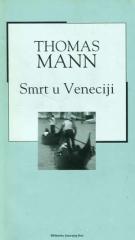
Smrt u Veneciji

Smrt u Veneciji

Thomas Mann
Jutarnji list, 2004.
Hrvatski. Latinica. Tvrde korice s ovitkom.
3,42
Tonio Kröger

Tonio Kröger

Thomas Mann
Zora, 1951.
Hrvatski. Latinica. Broširano.
4,68
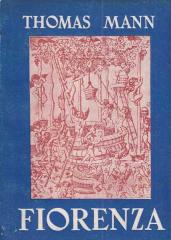
Fiorenza

Fiorenza

Thomas Mann
Zora, 1955.
Hrvatski. Latinica. Broširano s ovitkom.
6,425,14
Stotina godina (antikronika)

Stotina godina (antikronika)

Dario Harjaček

The novel One Hundred Years by Dario Harjaček provides a panoramic view of Trešnjevka and its inhabitants through a century of changes, ideologies, and human destinies – a mosaic of Zagreb in which life, art, and history intertwine.

Oceanmore, 2025.
Hrvatski. Latinica. Broširano.
13,42
Deobe

Deobe

Dobrica Ćosić

Deobe is a novel about the tragic division of Serbs into Chetniks and Partisans during World War II. Winner of the NIN Award, it is part of a wider epic trilogy, inspired by Ćosić's experiences and historical documents.

Prosveta, 1963.
Hrvatski. Latinica. Tvrde korice s ovitkom.
13,74
Andrićeva lestvica užasa

Andrićeva lestvica užasa

Svetislav Basara

Srpski pisac poznat po satiričnim romanima, u Andrićevoj lestvici užasa secira balkanski mentalitet kroz parabolu jugonostalgije i nacionalnih mitova. Naziv aludira na Ivu Andrića kao lakmus-papir za kritiku – Balkanci ga svojataju ili odbacuju po volji.

24 sata, 2021.
Srpski. Latinica. Broširano.
11,56